Мир перемен. 2026. № 3
Мир перемен. 2026. № 3.
- содержание аннотация contents summary
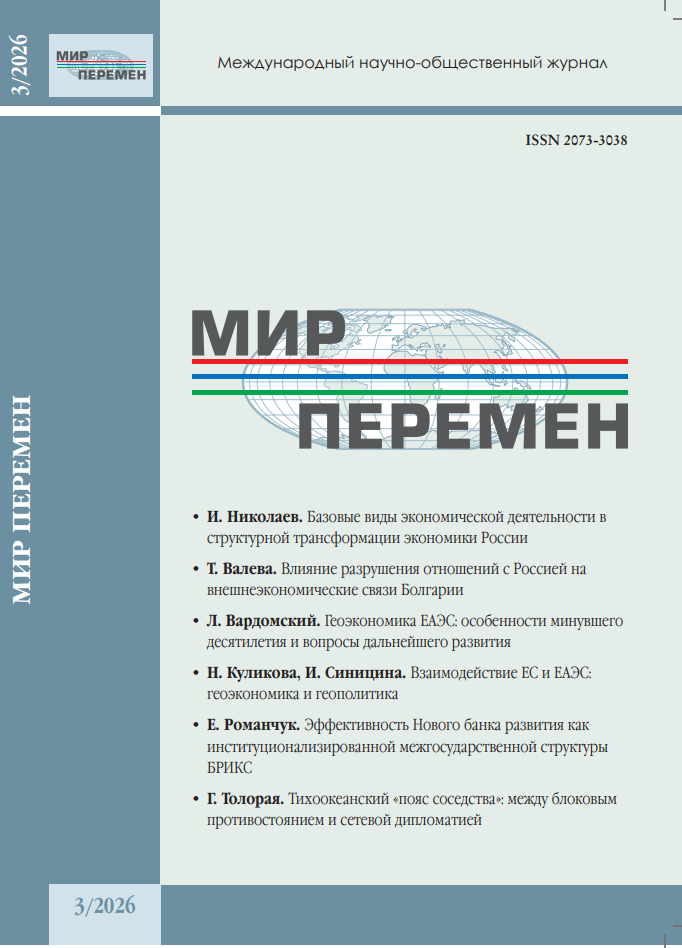
СОДЕРЖАНИЕ
Актуальные вопросы экономики
И. Николаев. Базовые виды экономической деятельности в структурной трансформации экономики России
Т. Валева. Влияние разрушения отношений с Россией на внешнеэкономические связи Болгарии
И. Бирюк. Возможности развития цифровой экосистемы российского туризма для улучшения социально-трудовых отношений.
Геоэкономика: сегодня и завтра
Л. Вардомский. Геоэкономика ЕАЭС: особенности минувшего десятилетия и вопросы дальнейшего развития
Н. Куликова, И. Синицина. Взаимодействие ЕС и ЕАЭС: геоэкономика и геополитика
Е. Романчук. Эффективность Нового банка развития как институционализированной межгосударственной структуры БРИКС
Г. Толорая. Тихоокеанский «пояс соседства»: между блоковым противостоянием и сетевой дипломатией
Политика и право
С. Луценко. Гуманитарная интервенция как проблема международного права
Публицистика
А. Ципко. Размышления о большевистской украинизации УССР
У книжной полки
Б. Шмелев. США во внешней политике России (рецензия на монографию А. Косова «США во внешней политике России в условиях трансформации современного миропорядка»)
АННОТАЦИЯ
И. Николаев. Базовые виды экономической деятельности в структурной трансформации экономики России
УДК: 330.341.42
EDN: QNSARQ
DOI: 10.51905/2073–3038_2026_3_05
То, как развиваются базовые виды экономической деятельности (ВЭД) – сельское хозяйство, промышленность, строительство, торговля и транспорт, – является важной информацией – индикатором реального состояния дел в экономике. Немалое значение с точки зрения устойчивости российской экономики имеет показатель доли валовой добавленной стоимости базовых ВЭД в совокупной валовой добавленной стоимости (ВДС): какова динамика этого показателя, за счет чего происходит изменение значений соответствующих отраслевых индикаторов и какие могут быть последствия данных процессов. К 2026 г. доля базовых ВЭД российской экономики снизилась до рекордно низких значений. Это значимый структурный сдвиг, свидетельствующий о снижении устойчивости экономики.
Ключевые слова: ВВП, базовые виды экономической деятельности (ВЭД), структурная трансформация, валовая добавленная стоимость (ВДС).
Игорь Алексеевич Николаев – доктор экономических наук, главный научный сотрудник Института экономики РАН (г. Москва).
Т. Валева. Влияние разрушения отношений с Россией на внешнеэкономические связи Болгарии
УДК: 327
EDN: JVZEVX
DOI: 10.51905/2073–3038_2026_3_16
Геополитическая напряженность и на ее фоне поляризация политических сил в основных экономических партнерах Болгарии негативно воздействовали на изменение объемов, товарной и географической структуры болгарской внешней торговли, на приток иностранных инвестиций, рост промышленного производства и финансовую стабильность. В 2025–2026 гг. Болгария стала полноправным членом Шенгенского пространства и вошла в зону евро (с 1 января 2026 г.), т. е. максимально интегрировалась в Европейский союз. Но при этом она стала частью Европы, которая к концу 2025 г. превратилась в заложника своих амбиций морального лидерства в мире без правил. Дополнительные проблемы, как и у всех союзников Болгарии, возникли в связи с военными действиями США и Израиля на Ближнем Востоке. Под давлением оказалась энергетическая безопасность страны. При полной поддержке Украины в конфликте, Болгария участвовала во всех антироссийских санкциях, введенных ЕС, США и присоединившимися к ним странами коллективного Запада. Однако в случае с Болгарией отрицательное воздействие на экономику страны оказали российские контрсанкции, тогда как болгарские санкции как таковые не вызвали проблем в развитии России. Проблемы, связанные с «отменой» России Болгарией в энергетике, в силу ограниченных потребностей и благоприятного географического положения страны в Юго-Восточной Европе, удалось решить, хотя и при существенных финансовых потерях. Оборудование, которое нельзя заменить в принципе (для функционирования АЭС «Козлодуй», Софийского метрополитена и т. п.), несмотря на санкционные рестрикции, продолжает поступать в Болгарию из России. Что же касается болгарского экспорта в РФ, то он и в лучшие годы не обеспечивал сколько-нибудь существенных потребностей российской экономики.
Ключевые слова: российско-болгарские отношения, товарооборот с Болгарией, поставки оборудования для АЭС в Болгарию, премьер-министр Болгарии Радев.
Татьяна Эмильевна Валева – кандидат географических наук, старший научный сотрудник Центра восточноевропейских исследований Института экономики РАН (г. Москва)
И. Бирюк. Возможности развития цифровой экосистемы российского туризма для улучшения социально-трудовых отношений.
УДК: 338.48
EDN: DMMFUN
DOI: 10.51905/2073–3038_2026_3_31
Статья посвящена проблемам и задачам цифровизации российского туризма, ее влиянию на социально-экономическое развитие регионов, в первую очередь на создание новых рабочих мест. Отмечается, что существующий государственный подход сосредоточен главным образом на сборе и предоставлении информации. Приводится обзор нормативных актов в области туризма, поддержки малого и среднего предпринимательства (МСП), а также креативных индустрий. Обосновывается необходимость создания цифровой туристической экосистемы в виде суперприложения, центром которого станут: сервис онлайн-бронирования средств размещения, маркетплейсы региональных производителей, платформа по созданию креативного контента и транспортный модуль (предусматривающий покупку государством агрегатора «Яндекс Такси»). В результате будут решены, с одной стороны, главные проблемы российских и иностранных туристов, а с другой – вопросы региональной занятости не только в туриндустрии, но и в традиционных отраслях.
Ключевые слова: цифровая экосистема туризма, региональная занятость, поддержка МСП, креативные индустрии, туристский маркетплейс, такси.
Илья Викторович Бирюк – экономист, шеф-редактор журнала «Мир перемен», старший редактор редакционно-издательского отдела Института экономики РАН (г. Москва).
Л. Вардомский. Геоэкономика ЕАЭС: особенности минувшего десятилетия и вопросы дальнейшего развития
УДК: 327; 339,9; 338,1.
EDN: QCODQY
DOI: 10.51905/2073–3038_2026_3_43
На основе геоэкономических подходов рассматриваются вопросы становления и развития ЕАЭС. Упомянутые подходы позволяют оценить реальные достижения Союза и постоянно возникающие новые вызовы для его деятельности. Благодаря расширению и корректировке институтов интеграции за десятилетие ЕАЭС обрел определенную устойчивость. С задержкой, но целенаправленно формируются отраслевые рынки ЕАЭС. В то же время усиливается внешнее воздействие на ЕАЭС с целью ухудшения его геоэкономики и прямой дезорганизации деятельности.
С новыми вызовами Союз и страны-участницы столкнулись в начале нового десятилетия своей работы. Эти вызовы обусловлены неравными условиями развития, в которых они оказались под влиянием санкций, а также и тем, что неизбежная в настоящих условиях многовекторность внешнеэкономических связей создает предпосылки для геополитической многовекторности. Трудности балансирования национальных интересов стран-участниц выражаются в ослаблении режима Таможенного союза. На этом фоне возрастает значение крупных совместных проектов, которые улучшают геоэкономику ЕАЭС и геоэкономические условия развития всех стран-участниц.
Ключевые слова: страны ЕАЭС, социально-экономические различия, национальные интересы, геоэкономика, интеграционные институты, проекты, связанность, геополитика, санкции Запада.
Леонид Борисович Вардомский – доктор экономических наук, главный научный сотрудник ФГБУН «Институт экономики РАН», заведующий Центром постсоветских исследований (г. Москва).
Н. Куликова, И. Синицина. Взаимодействие ЕС и ЕАЭС: геоэкономика и геополитика
УДК: 339.923
EDN: RZUTOI
DOI: 10.51905/2073–3038_2026_3_59
В статье проводится сравнительный анализ моделей экономической интеграции Евросоюза и Евразийского экономического союза в условиях трансформации мирового экономического порядка. Рассматриваются влияние европейской интеграции на формирование ЕАЭС, особенности институционального устройства двух объединений, масштабы и структура их экономического взаимодействия. Особое внимание уделено изменениям торговых связей между ЕС и государствами ЕАЭС после 2022 г. под воздействием санкционной политики, перестройки логистических цепочек и переориентации внешней торговли. Делается вывод, что геополитическое противостояние привело к фактическому прекращению институционального взаимодействия между двумя интеграционными объединениями, тогда как экономические связи сохраняются в формате двусторонних отношений и постепенно трансформируются под влиянием процессов регионализации, диверсификации торговых потоков и формирования новых центров экономического притяжения.
Ключевые слова: Евросоюз, ЕАЭС, международная торговля, внешнеэкономические санкции.
Наталия Владимировна Куликова – кандидат географических наук, ведущий научный сотрудник, заведующая Центром восточноевропейских исследований ИЭ РАН (г. Москва).
Ирина Сергеевна Синицина – кандидат экономических наук, ведущий научный сотрудник Центра восточноевропейских исследований ИЭ РАН (г. Москва).
Е. Романчук. Эффективность Нового банка развития как институционализированной межгосударственной структуры БРИКС
УДК: 339.7, 339.9
EDN: ZVVHPV
DOI: 10.51905/2073–3038_2026_3_82
В статье проводится оценка эффективности деятельности Нового банка развития (НБР) как альтернативного института в системе многосторонних банков развития для БРИКС с точки зрения финансовых показателей, предоставления площадки для выработки акционерами совместных решений и координации их действий, а также влияния на экономическое развитие государств, включая наращивание их технологической мощи. По итогам проведенного анализа автор приходит к выводу, что, несмотря на высокие показатели НБР по наращиванию проектного портфеля в странах операций, аналитическая деятельность в Банке развита довольно слабо, вследствие чего организация не готова предлагать решения для преодоления стоящих перед БРИКС вызовов. При этом автор отмечает, что предпринимаемые руководством НБР усилия по формированию альтернативной Западу модели развития БРИКС сталкиваются с ограничениями, заложенными при учреждении Банка.
Ключевые слова: БРИКС, Новый банк развития, многосторонние банки развития.
Екатерина Сергеевна Романчук – научный сотрудник Института экономики Российской академии наук, младший научный сотрудник Финансового университета при Правительстве Российской Федерации (г. Москва).
Г. Толорая. Тихоокеанский «пояс соседства»: между блоковым противостоянием и сетевой дипломатией
УДК: 327
EDN: TSETIF
DOI: 10.51905/2073–3038_2026_3_107
В статье рассматривается геополитическая динамика в Восточной и Юго-Восточной Азии в условиях слома послевоенного миропорядка. Автор вводит понятие «сердцевинной Азии» (Core Asia) и анализирует концептуальное противостояние между инклюзивной моделью Азиатско-Тихоокеанского региона (АТР) и конфронтационной логикой Индо-Тихоокеанского региона (ИТР). Исследуются вызовы для АСЕАН, включая блоковую фрагментацию, утрату субъектности. Особое внимание уделено V саммиту Россия – АСЕАН в Казани (2026 г.) как рубежу 35-летнего диалога. Предлагаются сценарии развития региона на 5–10 лет и обосновывается роль России как балансира, сохраняющего инклюзивную архитектуру безопасности при одновременном развитии прагматичного сотрудничества со странами субрегиона.
Ключевые слова: АТР, ИТР, АСЕАН, «сердцевинная Азия», Россия – АСЕАН, многополярность, инклюзивная безопасность, минилатерализм, Казань 2026.
Георгий Давидович Толорая – доктор экономических наук, профессор, руководитель Центра стратегии России в Азии ИЭ РАН, главный научный сотрудник Центра мировой политики и стратегического анализа Института Китая и современной Азии РАН (г. Москва).
С. Луценко. Гуманитарная интервенция как проблема международного права
УДК: 341.211; 341.233
EDN: DXHCNZ
DOI: 10.51905/2073–3038_2026_3_127
Автор рассматривает особенности концепции гуманитарной интервенции как части международного права в плоскости защиты прав граждан. Гуманитарная интервенция – составляющий элемент международного права. Ее применение оправданно в межгосударственных конфликтах, в случаях преступлений против человечности, грубых нарушений прав человека (включая дискриминацию по языковому признаку). И является последним средством военного принуждения в межгосударственных конфликтах, включая геноцид, этнические чистки, грубые нарушения прав. ООН обладает полномочиями в отношении проведения гуманитарной интервенции. В случае бездействия данной международной инстанции государство (или группа государств) приобретает компетенцию для проведения подобной миссии, с учетом правового обоснования вмешательства и надлежащих доказательств. Целью данной статьи является выработка единого подхода к категории «гуманитарная интервенция» с использованием международной правоприменительной практики.
Ключевые слова: международное гуманитарное право, гуманитарная интервенция, Устав ООН, Совет Безопасности ООН, Международная комиссия по интервенции и государственному суверенитету, права человека.
Сергей Иванович Луценко – директор Центра экономического анализа права и проблем правоприменения Института экономических стратегий Отделения общественных наук РАН, член экспертного совета комитета Государственной думы Федерального собрания РФ по обороне (г. Москва).
А. Ципко. Размышления о большевистской украинизации УССР
УДК: 323.1
EDN: UMPUBT
DOI: 10.51905/2073–3038_2026_3_147
«Советская образованщина», о которой говорил А. Солженицын, проявилась и в нашем прочтении истории отношений между теми, кого до «русской весны» 2014 г. мы называли «братьями» и кого теперь называем «разделенной нацией». В советское время и, к сожалению, после распада СССР наша политическая элита проявляла поразительное равнодушие к тому, что было написано о природе украинскости и украинском сепаратизме до Великой Октябрьской социалистической революции. И поэтому в то время, да и сейчас, в оценке отношений между русскими и украинцами проявляются две крайности: во-первых, недооценка украинскости как антирусскости; во-вторых, умаление значения различий между украинским национализмом политической элиты и интеллигенции Украины и отношением украинского народа (прежде всего крестьянства) к идее независимости от России.
Ключевые слова: М. Грушевский, В. Винниченко, гетман Украины П. Скоропадский, «великодержавный русский шовинизм», В. Ленин, большевистская программа украинизации, национальная политика, обязательное изучение украинского языка, интернационализм.
Александр Сергеевич Ципко – доктор философских наук, главный научный сотрудник Института экономики РАН (г. Москва).
Б. Шмелев. США во внешней политике России
рецензия на монографию А. Косова «США во внешней политике России в условиях трансформации современного миропорядка»: монография / А. П. Косов; под ред. В. С. Кошелева. Витебск: ВГУ имени П. М. Машерова, 2024. 366 с.
УДК: 327
EDN: FWATXY
DOI: 10.51905/2073–3038_2026_3_170
Поступательная деградация российско-американских отношений, происходящая на наших глазах, бесспорно, относится к числу важнейших дестабилизирующих факторов в постбиполярной системе международных отношений. Все более очевидными становятся принципиальные расхождения между Москвой и Вашингтоном в понимании сегодняшней международной повестки. РФ и США по-разному видят основополагающие принципы современного мироустройства и свою роль в миропорядке XXI в. Неудивительно, что данные реалии подстегивают дискуссии и споры внутри экспертных сообществ разных стран относительно динамики развития российско-американских отношений. Не исключением стала и работа белорусского исследователя – доцента кафедры истории и культурного наследия Витебского государственного университета имени П. М. Машерова, кандидата исторических наук А. П. Косова.
Ключевые слова: миропорядок, противоречия, Россия, США, постбиполярная система, интересы, партнерство.
Борис Александрович Шмелев – доктор исторических наук, главный научный сотрудник, руководитель Сектора политических исследований Института экономики РАН (г. Москва)
С начала 1997 г. Горбачев-Фонд после обстоятельного обсуждения проблемы взялся за осуществление большого и очень трудного (мы в этом уже убедились), но крайне необходимого проекта: «XXI век – век глобальных вызовов и ответов», патроном которого я являюсь. Мы рассматриваем это как русскую инициативу, но все-таки смотрим на наш проект с позиции международной. Считаем этот проект международным и по своему характеру, и по подходам к его осуществлению. Мы с самого начала поставили перед собой задачу осуществлять этот проект в сотрудничестве с научными, интеллектуальными центрами всех континентов нашего земного шара. Мы пригласили в кураториум проекта многих видных политиков, известных авторитетных людей. Среди них экс-президент ФРГ Р. фон Вайцзеккер, лауреат Нобелевской премии мира Ш. Перес, бывший Генеральный секретарь ООН Б. Гали, бывший вице-канцлер ФРГ Г.-Д. Геншер, экс-премьер Нидерландов Р. Любберс, бывший госсекретарь США Г. Киссинджер, экс-премьер Японии Я. Накасонэ, президент ЮАР Н. Мандела и другие, не буду всех перечислять. Мы были очень рады, что наша идея встретила понимание и поддержку. Это нас еще раз убедило в том, что мы сделали правильный выбор.
Ключевые слова: глобальные мировые вызовы, холодная война, новая модель мира, экология, доступность пресной воды, новая политическая архитектура, многополярность.
Михаил Сергеевич Горбачев – генеральный секретарь ЦК КПСС, первый и последний президент СССР (г. Москва).
Contents
Current Economic Issues
I. Nikolaev. Core Economic Activity in the Structural Transformation of the Russian Economy
T. Valeva. The Impact of the Rupture of Relations with Russia on Bulgaria’s Foreign Economic Ties
I. Biryuk. Opportunities for Developing the Digital Ecosystem of Russian Tourism to Improve Social and Labor Relations
Geoeconomics: Today and Tomorrow
L. Vardomskiy. Geoeconomics of the EAEU: Features of the Past Decade and Prospects of Further Development
N. Kulikova, I. Sinitsina. EU – EAEU Interaction: Geoeconomics and Geopolitics
E. Romanchuk. The Effectiveness of the New Development Bank as an Institutionalized Intergovernmental Structure of BRICS
G. Toloraya. The Pacific «Neighborhood Belt»: between Bloc Confrontation and Network Diplomacy
Politics and Law
S. Lutsenko. Humanitarian Intervention as a Problem of International Law
Publicism
A. Tsipko. Reflections on the Bolshevik Ukrainization
By the Bookshelf
B. Shmelev. The United States in Russia’s Foreign Policy (Review of A. Kosov’s Monograph «The United States in Foreign Policy Russia in the Context of the Transformation of the Modern World Order»)
The Misunderstood Prophet
M. Gorbachev. The 21st Century – the Century of Global Challenges and Responses (Speech at the Roundtable «The Global World: Challenges and Responses» in Mårsund, Lofoten Islands, Norway, May 12, 1998)
Summary
I. Nikolaev. Core Economic Activity in the Structural Transformation of the Russian Economy
Annotation. The development of core economic activities (TEA) (agriculture, industry, construction, trade, and transportation) serves as a crucial indicator of the economy’s actual state. The share of gross value added (GVA) generated by these core activities within the total GVA is of significant importance for the resilience of the Russian economy; it is essential to analyze the dynamics of this indicator, the factors driving changes in the corresponding sectoral metrics, and the potential consequences of these processes. By 2026, the share of core foreign trade activities in the Russian economy had fallen to record low. This represents a significant structural shift, signaling a decline in economic resilience.
Keywords: GDP, core economic activities, structural transformation, gross value added (GVA)
Igor A. Nikolaev – Doctor of Economic Sciences, Chief Researcher of the Institute of Economics of the Russian Academy of Sciences (Moscow).
T. Valeva. The Impact of the Rupture of Relations with Russia on Bulgaria’s Foreign Economic Ties
Abstract. Geopolitical tensions and, the accompanying polarization of political forces among Bulgaria’s key economic partners had negatively affected change in the volume, commodity composition and geographical structure of Bulgarian foreign trade, as well as foreign investment inflows, industrial output growth and financial stability. In 2025–2026 Bulgaria became a full member of the Schengen Area and joined the Eurozone (effective 1st of January 2026), thereby achieving maximum integration into the European Union. Yet, in doing so, it became part of Europe, that, by the end of 2025, had become a hostage of its own ambitions for moral leadership in a world devoid of rules. Additional challenges, arose – as they did for all of Bulgaria’s allies – due to military actions of the US and Israel in the Middle East. The country’s energy security came under pressure. While fully supporting Ukraine e conflict, Bulgaria participated in all anti-Russian sanctions, imposed by the EU, the US, and other nations of the collective West. However, in Bulgaria’s case, the country’s economy suffered negative impacts from Russian counter-sanctions, whereas Bulgarian sanctions per se did not hinder Russia’s development. Challenges, stemming from Bulgaria’s «decoupling» from Russia in the energy sector were successfully resolved – albeit at significant financial cost – thanks to the country’s limited energy needs and its favorable geographical location in Southeast Europe. Equipment that is fundamentally irreplaceable (for the operation of the Kozloduy NPP and the Sofia metro, etc.), continues to be supplied to Bulgaria from Russia, notwithstanding sanctions-related restrictions. As for Bulgarian exports to the Russian Federation, even in the best of times, they did not meet any significant needs of the Russian economy.
Keywords: Russian-Bulgarian relations, trade turnover with Bulgaria, supplies of equipment for nuclear power plants to Bulgaria, Bulgarian Prime Minister Radev.
Tatiana E. Valeva – Candidate of Geographical Sciences and a Senior Research Fellow at the Centre for the East European Studies, Institute of Economics of the Russian Academy of Sciences (Moscow).
I. Biryuk. Opportunities for Developing the Digital Ecosystem of Russian Tourism to Improve Social and Labor Relations
Abstract. The article is devoted to the problems and challenges of digitalizing Russian tourism and its impact on the socio-economic development of regions, primarily on the creation of new jobs. It is noted that the existing state approach is mainly focused on collecting and providing information. An overview of regulatory acts in the field of tourism, support for small and medium-sized businesses, and creative industries is provided. The necessity of creating a digital tourism ecosystem in the form of a super-app is substantiated, the center of which will be: an online accommodation booking service, marketplaces for regional producers, a platform for creating creative content, and a transport module (which involves the state purchasing the Yandex Taxi aggregator). As a result, on the one hand, the main problems of Russian and foreign tourists will be resolved, and on the other hand, issues of regional employment will be addressed – not only in the tourism industry but also in traditional sectors.
Keywords: digital tourism ecosystem, regional employment, SME support, creative industries, tourism marketplace, taxi.
Ilya V. Biryuk – Economist, Chief Editor of the Magazine «World of Changes», Senior Editor of the Editorial and Publishing Department of the Institute of Economics of the Russian Academy of Sciences (Moscow).
L. Vardomskiy. Geoeconomics of the EAEU: Features of the Past Decade and Prospects of Further Development
Annotation. This article examines the formation and development of the Eurasian Economic Union (EAEU) through the lens of geoeconomic approaches. These approaches make it possible to assess the Union’s tangible achievements alongside the new, recuing challenges it faces.
Over the past decade, the expansion and refinement of its integration institutions have granted the EAEU a certain degree of stability. Sectoral markets within the EAEU are taking shape – albeit with some delays – in a purposeful manner. Simultaneously, the external pressure on the EAEU is intensified aimed at worsening its geoeconomics and directly disrupting its operations. As the Union and its member states entered a new decade of cooperation, they faced new challenges. These stem from the unequal development conditions resulting from sanctions, as well as by the fact that a multi-vector approach to foreign economic relations – unavoidable under current circumstances creates the preconditions for a multi-vector geopolitical orientation. The difficulties of balancing national interests of member states has manifested in weakening the Customs Union regime. Against this backdrop, the importance of large-scale joint projects has grown; such initiatives serve to improve the EAEU’s geoeconomics and enhance the geoeconomic conditions for development across all member states.
Keywords: EAEU countries, socio-economic differences, national interests, geoeconomics, integration institutions, projects, connectivity, geopolitics, and Western sanctions.
Leonid B. Vardomskiy – Doctor of Economic Sciences, Chief Research Fellow at the Institute of Economics of the Russian Academy of Sciences (RAS) and Head of the Center for Post-Soviet Studies (Moscow).
N. Kulikova, I. Sinitsina. EU – EAEU Interaction: Geoeconomics and Geopolitics
Abstract. The article presents a comparative analysis of the models of economic integration of the European Union and the Eurasian Economic Union within the context of the transformation of the global economic order. It examines the influence of European integration on the formation of the EAEU, the specific features of the institutional frameworks of the two unions, and the scale and structure of their economic interaction. Particular attention is paid to shifts in trade relations between the EU and the EAEU member states after 2022, driven by sanctions policy, the restructuring of logistics chains, and the reorientation of foreign trade. The authors conclude that the geopolitical confrontation has led to the effective cessation of institutional interaction between the two integration blocs, while economic ties persist through bilateral relations and are gradually transforming under the influence of regionalization processes, the diversification of trade flows, and the formation of news centers of economic gravity.
Keywords: European Union, EAEU, international trade, foreign economic sanctions.
Natalia V. Kulikova – Candidate of Geographical Sciences, a Leading Researcher, and the Head of the Center for Eastern European Studies at the Institute of Economics of the Russian Academy of Sciences (RAS, Moscow).
Irina S. Sinitsina – Candidate of Economic Sciences, a Leading Researcher at the Center for Eastern European Studies at the Institute of Economics of the Russian Academy of Sciences (RAS, Moscow).
E. Romanchuk. The Effectiveness of the New Development Bank as an Institutionalized Intergovernmental Structure of BRICS
Abstract. The article evaluates the effectiveness of the New Development Bank (NDB) – a multilateral development bank serving the BRICS nations – by examining its financial performance, its role as a platform for shareholders to develop joint decisions and coordinate their actions, as well as influence the economic development of states, including the enhancement of their technological capabilities.
Based on the results of the analysis, the author concludes that despite the NDB’s high performance in building up its project portfolio in the countries of operation, the bank’s analytical capacity remains underdeveloped, and, consequently, the organization is not yet well-positioned to offer solutions to overcome the challenges facing the BRICS. Furthermore, the author notes that the efforts undertaken by the leadership of the NBR to form an alternative model of BRICS development to the West face the limitations inherent in the in the bank’s founding framework.
Keywords: BRICS, New Development Bank, multilateral development banks.
Ekaterina S. Romanchuk – Researcher at the Institute of Economics of the Russian Academy of Sciences (RAS), Junior Researcher at the Financial University under the Government of the Russian Federation (Moscow).
G. Toloraya. The Pacific «Neighborhood Belt»: between Bloc Confrontation and Network Diplomacy
Annotation. The article examines the position and role of the countries of East and Southeast Asia amid the global geopolitical collapse, which was triggered by the exhaustion of the post-war world order model, based on Western dominance. The author introduces the concept of «Core Asia» as an analytical tool for understanding the specificity of this subregion, which is united by Confucian-Buddhist values, a shared historical destiny, and deep economic interconnectedness. The focus is on the conceptual confrontation between the inclusive model of the Asia-Pacific region (APR), centred on ASEAN, and the exclusive, confrontational logic of the Indo-Pacific region (IPR) promoted by the United States and its allies. The article considers the risks of the «spillover» of global conflicts into the ASEAN area of responsibility, the degradation of multilateral mechanisms, and the threat of loss of agency for small and medium-sized countries in the region. Particular attention is paid to the results of the 5th Russia–ASEAN Summit, which took place in Kazan (in June of 2026), which marked a milestone in the 35-year long dialogue. The author argues that Russia needs to maintain its status as a «balancer» and guarantor of an inclusive security architecture, proposing development scenarios for the next 5–10 years – ranging from bloc fragmentation to Eurasian synthesis. It is concluded that Russia’s «turn to the East» should be filled with specific projects in energy sovereignty, cybersecurity, and logistics, while avoiding superfluous dependence on China and simultaneously countering bloc discrimination from the West.
Keywords: Asia-Pacific (APR), Indo-Pacific (IPR), ASEAN, Core Asia, Russia – ASEAN, multipolarity, inclusive security, minilateralism, Kazan 2026.
Georgy D. Toloraya – Doctor of Economic Sciences, Professor, Head of the Centre for Russian Strategy in Asia at the Institute of Economics of the Russian Academy of Sciences; Chief Researcher at the Centre for World Policy and Strategic Analysis at the Institute of China and Contemporary Asia at the Russian Academy of Sciences (Moscow).
S. Lutsenko. Humanitarian Intervention as a Problem of International Law
Abstract. The author examines key features of the concept of humanitarian as a component of international law, specifically within the context of protecting citizens’ rights. Humanitarian intervention is an integral element of international law. Its intervention is justified in inter-State conflicts, in cases involving crimes against humanity, or gross violations of human rights (including linguistic discrimination based).
It serves as a measure of last resort involving military coercion in interstate conflicts – such as those involving genocide, ethnic cleansing, or gross rights violations. The UN holds the authority to conduct humanitarian interventions. Should this international body fail to act, a state (or group of states) acquires the competence to carry out such a mission, provided there is a legal basis for the intervention and sufficient evidence. This article aims to formulate a unified approach to the concept of «humanitarian intervention» by drawing upon international legal practice.
Keywords: international humanitarian law, humanitarian intervention, UN Charter, UN Security Council, International Commission on Intervention and State Sovereignty, human rights
Sergey I. Lutsenko – Director of the Center for Economic Analysis of Law and Law Enforcement Problems, Institute of Economic Strategies of the Department of Social Sciences of the Russian Academy of Sciences; Member of the Expert Council of the Defense Committee of the State Duma of the Federal Assembly of the Russian Federation (Moscow).
A. Tsipko. Reflections on the Bolshevik Ukrainization
Abstract. The “Soviet-style pseudo-intelligentsia” – a term which was used by A. Solzhenitsyn – has also manifested in our interpretation of the history of relations between those whom we called “brothers” before the “Russian Spring” of 2014, and whom we now refer to as a “divided nation”. Both during the Soviet era and, regrettably, following the collapse of the USSR, our political elite had shown a striking indifference toward what was written about the nature of “Ukrainian-ness” and Ukrainian separatism prior to the Great October Socialist Revolution. Consequently, both then and now, the assessment of relations between Russians and Ukrainians has been characterized by two extremes: first, an underestimation of the extent to which “Ukrainian-ness” is inherently anti-Russian; and second, a failure to distinguish between the Ukrainian nationalism espoused by the Ukrainian political elite and intelligentsia, on the one hand, and the attitude of the Ukrainian people – most notably the peasantry – toward the idea of independence from Russia, on the other.
Keywords: Mikhail Grushevsky, V. Vynnychenko, Hetman of Ukraine Skoropadsky, “Great-Power Russian chauvinism”, Lenin, the Bolshevik program for the Ukrainization of Ukraine, national policy, mandatory study of the Ukrainian language, internationalism.
Alexander S. Tsipko – Doctor of Philosophical Sciences, Chief Researcher at the Institute of Economics of the Russian Academy of Sciences (RAS).
B. Shmelev. The United States in Russia’s Foreign Policy (Review of A. Kosov’s Monograph «The United States in Foreign Policy Russia in the Context of the Transformation of the Modern World Order»)
Abstract. The progressive deterioration of Russian-American relations, which is unfolding before our eyes, undoubtedly belongs to the number of the most important destabilizing factors in the post‑bipolar system of international relations. Major differences between Moscow and Washington in their understanding of the modern world order are becoming increasingly obvious. The Russian Federation and the United States have different views on the fundamental principles of the modern world order and their role in the world order of the 21st century. It is not surprising that these realities fuel discussions and debates within expert communities in different countries, concerning the dynamics of the development of Russian‑American relations. The work of the Belarusian researcher, Associate Professor at the Department of History and Cultural Heritage at Vitebsk State University named after P. M. Masherov, Candidate of Historical Sciences, Associate Professor A. P. Kosov, was no exception.
Keywords: world-oder, contradictions, Russia, USA, post-bipolar system, interests, partnership.
Boris A. Shmelev – Doctor of Historical Sciences, Chief Researcher, Head of the Policy Research Sector at the Institute of Economics of the Russian Academy of Sciences (Moscow).
M. Gorbachev. The 21st Century – the Century of Global Challenges and Responses (Speech at the Roundtable «The Global World: Challenges and Responses» in Mårsund, Lofoten Islands, Norway, May 12, 1998)
Abstract. Since the beginning of 1997, the Gorbachev Foundation, following a thorough discussion of the issue, undertook a major large and very challenging (as we have since discovered) but extremely essential project: “The 21st Century – an Era of Global Challenges and Responses,” of which I am the patron. While we view this as a Russian initiative, we approach the project from an international perspective. We consider it international in both its nature and its implementation strategy. From the very beginning, our goal has been to carry out this project in cooperation with scientific and intellectual centers across every continent of the globe.
We invited many prominent politicians and distinguished authoritative figures to join the project’s advisory board. Among them are former President of the Federal Republic of Germany R. von Weizsäcker and Nobel Peace Prize laureate Sh. Perez, former UN Secretary – General B. Gali, former Vice-Chancellor of Germany G.-D. Genscher, former Prime Minister of the Netherlands R. Lubbers, former US Secretary of State H. Kissinger, former Prime Minister of Japan Y. Nakasone, President of South Africa N. Mandela, and others – I will not list them all. We were delighted to find out that our idea met with understanding and support. This confirmed to us once again that we had made the right choice.
Keywords: global world challenges, cold war, new model of the world, ecology, availability of fresh water, global world challenges, new political architecture, multipolarity.
Mikhail S. Gorbachev – General Secretary of the Central Committee of the CPSU, the First and Last President of the USSR (Moscow).