Мир перемен. 2026. № 1
Мир перемен. 2026. № 1.
- содержание аннотация contents summary
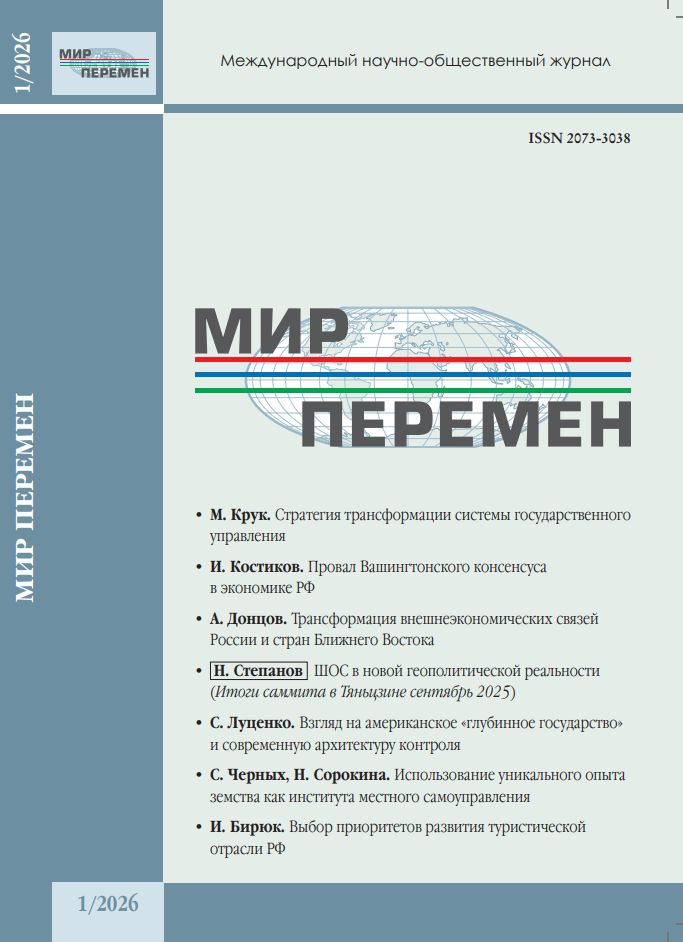
СОДЕРЖАНИЕ
Актуальные вопросы экономики
А. Донцов. Трансформация внешнеэкономических связей России и стран Ближнего Востока в условиях санкционного давления западных стран
Н. Степанов. ШОС в новой геополитической реальности (Итоги саммита в Тяньцзине сентябрь 2025)
И. Костиков. Провал Вашингтонского консенсуса в экономике РФ
И. Бирюк. Выбор приоритетов развития туристической отрасли Российской Федерации
Государственное строительство
М. Крук. Стратегия трансформации системы государственного управления
С. Черных, Н. Сорокина. К вопросу использования уникального опыта земства как института местного самоуправления
Геополитика сегодня и завтра
С. Луценко. Взгляд на американское «глубинное государство» и современную архитектуру контроля
Публицистика
А. Ципко. Духовный подвиг Н. Хрущева
У книжной полки
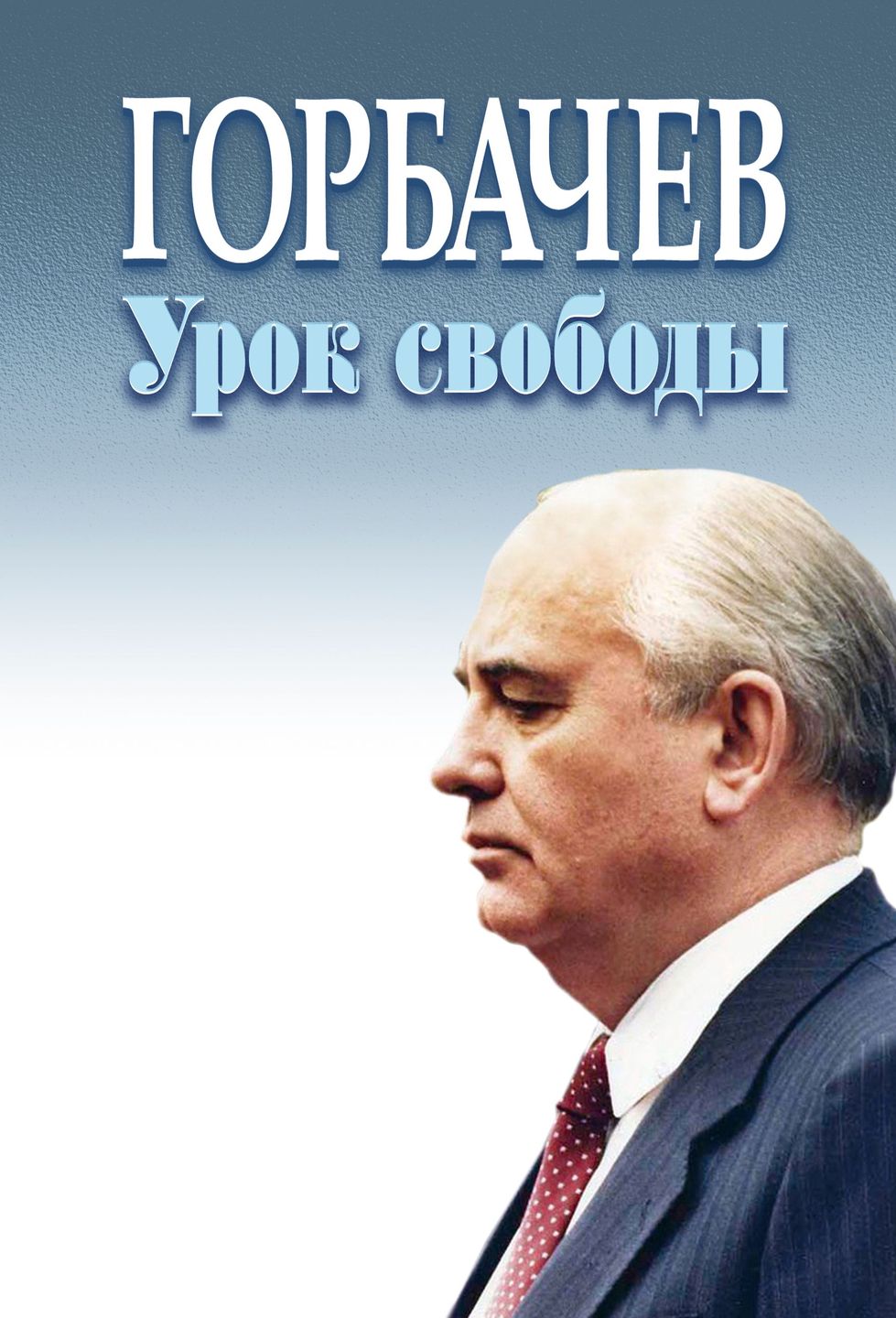
А. Матлин. Первый президент в истории России (Рецензия на монографию А. С. Пученкова «Генсек и Президент: М. С. Горбачев в 1990–1991 гг.»)
Непонятый пророк
М. Горбачев. Современному миру нужна новая политика (Выступление на Форуме новой политики, Люксембург, 18 мая 2012 г.)
М. Горбачев. Лидерство и успех в XXI веке (Выступление на семинаре американской организации «Ресурсы успеха», Орландо, шт. Флорида, 3 ноября 2012 г.)
АННОТАЦИЯ
А. Донцов. Трансформация внешнеэкономических связей России и стран Ближнего Востока в условиях санкционного давления западных стран
УДК: 339.9; 327; 339.92
EDN: HPXHKS
DOI: 10.51905/2073–3038_2026_1_05
Цель исследования – анализ механизмов и инструментов трансформации внешнеэкономических связей России со странами Ближнего Востока в нынешних условиях
и разработка предложений по реализации устойчивой интеграционной модели сотрудничества. Ключевой исследовательский вопрос статьи – каким образом санкции
стали катализатором формирования новой архитектуры сотрудничества «Юг–Юг» между Россией и странами
Ближнего Востока, и насколько эта модель независима от
западно-ориентированных норм глобального управления.
Результаты исследования демонстрируют, что в ответ на санкции Россия и ее партнеры на Ближнем Востоке
разработали комплексную интеграционную модель, основанную на двух ключевых элементах. Делается вывод, что
формирующаяся модель представляет проактивный инструмент многополярного сотрудничества, обеспечивающий экономический суверенитет и устойчивость.
Ключевые слова: санкции, Россия, Ближний Восток, внешнеэкономическая стратегия, дедолларизация, правовая адаптация, интеграционная модель, бартер, финансовый суверенитет, технологический суверенитет.
Александр Александрович Донцов – доктор философских наук, научный сотрудник факультета мировой экономики и мировой политики в Национальном исследовательском университете «Высшая школа экономики», (г. Москва).
Н. Степанов. ШОС в новой геополитической реальности (Итоги саммита в Тяньцзине сентябрь 2025)
УДК: 327.5
EDN: QGOHFL
DOI: 10.51905/2073–3038_2026_1_25
Шанхайская организация сотрудничества (ШОС) в условиях углубляющейся международной напряженности и трансформации мировой системы приобретает качественно новую роль одного из ключевых центров силы в Евразии. На этом фоне 25-й саммит ШОС в Тяньцзине, завершившийся принятием Тяньцзиньской декларации и Стратегии развития ШОС до 2035 г., выступает рубежным событием, задающим долгосрочные ориентиры политического, экономического и институционального развития организации.
Проведенный анализ показывает, что Тяньцзиньская декларация фиксирует консенсус государств – членов ШОС в пользу укрепления многополярного мироустройства, реформы глобального управления и расширения повестки организации в сферах безопасности, устойчивого развития и технологического сотрудничества. Стратегия развития ШОС до 2035 г. институционализирует эти установки, задавая долгосрочные цели в области борьбы с терроризмом, развития инфраструктуры и энергетики, дедолларизации расчетов, формирования банка развития и углубления взаимодействия с другими региональными объединениями.
В совокупности данные документы подтверждают переход ШОС от преимущественно консультативного формата к более комплексной модели региональной организации, претендующей на самостоятельное место в формирующейся архитектуре евразийской безопасности и экономического сотрудничества.
Ключевые слова: Шанхайская организация сотрудничества; Тяньцзиньская декларация; Стратегия развития ШОС до 2035 г.; новая геополитическая реальность; евразийская интеграция; региональная безопасность; экономическое сотрудничество; многополярность; Иран в ШОС; инициатива «Пояс и путь»
Никита Сергеевич Степанов – кандидат экономических наук, старший научный сотрудник Института экономики РАН (г. Москва). С глубоким прискорбием сообщаем, что Никита Сергеевич скоропостижно скончался 21 марта 2026-го. Эта статья – одна из его последних работ.
И. Костиков. Провал Вашингтонского консенсуса в экономике РФ
УДК: 330.342:330.88
EDN: ZVSCRQ
DOI: 10.51905/2073–3038_2026_1_39
В статье анализируется институциональный характер экономической трансформации России в 1990–2024 г. и оценивается влияние политики Вашингтонского консенсуса (ВК) на формирование механизмов неэквивалентного обмена. На основе концепций state capture, path dependence, теории мир-систем и гипотезы Пребиша–Сингера проводится сравнительный анализ российской траектории развития и опыта стран Центральной Европы. Особое внимание уделяется роли приватизации, ресурсного суперцикла 2000-х годов и санкционной экономики после 2014 г. Показано, что санкции не устранили структурных признаков зависимости, а модифицировали их, усилив асимметричность внешнеэкономических связей. В заключение формулируются институциональные условия экономического суверенитета, понимаемого как способность снижать уязвимость к внешним финансовым, ценовым и технологическим шокам.
Ключевые слова: экономические реформы, Вашингтонский консенсус, институциональная трансформация, неэквивалентный обмен, приватизация, захват государства, эффект колеи, капиталоотток, ресурсная зависимость, санкции, экономический суверенитет, постсоциалистические трансформации.
Игорь Владимирович Костиков – доктор экономических наук, профессор, председатель Совета Межрегиональной общественной организации «Союз потребителей финансовых услуг» (г. Москва).
И. Бирюк. Выбор приоритетов развития туристической отрасли Российской Федерации
УДК: 338.48
EDN: ESVUBV
DOI: 10.51905/2073–3038_2026_1_76
В статье рассматриваются современные приоритеты государственной политики Российской Федерации в сфере туризма на фоне беспрецедентного бюджетного финансирования, запланированного в рамках национального проекта «Туризм и гостеприимство». Сравниваются объемы финансирования туристической отрасли и сферы сохранения объектов культурного наследия в контексте вопроса о стратегических целях государства и критически оценивается эффективность освоения бюджетных средств. Автором сформулирован ряд конкретных инструментов повышения привлекательности внутреннего туризма и развития регионального потенциала, соответствующих «Концепции развития креативных (творческих) индустрий». Реализация данных инициатив способна повысить удовлетворенность граждан туристическими услугами, развить цифровые сервисы и укрепить позитивный образ России как открытой и доступной для туристов страны.
Ключевые слова: цифровизация туризма, стратегия развития туризма, государственная поддержка туризма, платформенная занятость.
Илья Викторович Бирюк – экономист, шеф-редактор журнала «Мир перемен» старший редактор редакционно-издательского отдела Института экономики РАН (г. Москва)
М. Крук. Стратегия трансформации системы государственного управления
УДК: 351/354:005
EDN: WPEMSL
DOI: 10.51905/2073–3038_2026_1_89
В статье представлена комплексная концепция системной трансформации государственного управления в Российской Федерации. Проведена диагностика текущего состояния системы госуправления, выявлены ключевые структурные, процессные, кадровые и культурные проблемы. Разработана целевая модель эффективного развития, базирующаяся на принципах результативности, клиентоориентированности, открытости, инновационности и профессионализма. Определены пять ключевых направлений управленческих преобразований: институциональные реформы, развитие человеческого капитала, цифровая трансформация, внедрение современных управленческих технологий и трансформация организационной культуры. Предложен поэтапный план реализации концепции. Обоснована необходимость создания Института национальных стратегий в структуре РАН.
Ключевые слова: государственное управление, управленческие преобразования, цифровая трансформация, проектное управление, бережливое государство, управление по целям, организационная культура, стратегическое планирование.
Михаил Давидович Крук – доктор экономических наук, научный консультант Международного научно-исследовательского института проблем управления (МНИИПУ) (г. Москва).
С. Черных, Н. Сорокина. К вопросу использования уникального опыта земства как института местного самоуправления
УДК: 332.01.
EDN: REKHVY
DOI: 10.51905/2073–3038_2026_1_118
В статье рассматривается феномен земства – института местного самоуправления, существовавшего в Российской империи с 1864 по 1917 г. на уровне губернии, уезда и после революционных событий с 1917 по 1919 г. – на уровне волости. Формирование этого института связано с реформаторской деятельностью императора Александра II и прежде всего с крестьянской реформой 1861 г. и земской 1864 г. Александр II, освободив крестьян от крепостной зависимости, решил возродить земство в новой форме – как институт местного всесословного самоуправления.
Исторически этот институт действовал весьма небольшой отрезок времени, но тем не менее его роль значительна в налаживании местного хозяйства и инфраструктуры, в становлении материальной и политической культуры, духовной жизни российской провинции.
Авторы анализируют институт земства, во-первых, с точки зрения развития современной теории общественных институтов, во-вторых, в аспекте возможности использования земского опыта в практике современного государственного (муниципального) управления.
Ключевые слова: земство, местное самоуправление, государственное (муниципальное) управление, публичное управление, промежуточный институт, инклюзивные и экстрактивные институты, «вертикаль власти», опорный населенный пункт, Стратегия пространственного развития России до 2030 г. c прогнозом до 2036 г.
Сергей Иннокентьевич Черных – доктор экономических наук, профессор, главный научный сотрудник Центра исследований проблем государственного управления Института экономики РАН (г. Москва).
С. Луценко. Взгляд на американское «глубинное государство» и современную архитектуру контроля
УДК: 32.019.5; 004
EDN: HUBCTX
DOI: 10.51905/2073–3038_2026_1_137
Автор рассматривает особенности американского «глубинного государства» в плоскости военно-информационного комплекса. Компания Palantir является составляющим звеном глубинного государства, которая занимается сбором разведывательных данных (системой массовой слежки) и поддержкой государства в сфере национальной безопасности. Концепция «глубинного государства» связана с ведением войн за рубежом и вмешательством во внутренние дела суверенных государств.
Ключевые слова: «глубинное государство», «Палантир», DARPA, военно-информационный комплекс, Кремниевая долина, П. Тиль.
Сергей Иванович Луценко – директор Центра экономического анализа права и проблем правоприменения Института экономических стратегий Отделения общественных наук РАН, член экспертного совета комитета Государственной думы Федерального собрания РФ по обороне (г. Москва).
А. Ципко. Духовный подвиг Н. Хрущева
УДК: 323
EDN: RDDNUO
DOI: 10.51905/2073–3038_2026_1_150
Доклад Хрущева «О культе личности и его последствиях» на ХХ съезде КПСС в 1956 г. посвящен очищению идеалов ленинского Октября от крови сталинских репрессий. Я бы на месте РПЦ причислил к лику святых Н. Хрущева – человека, который дал счастье освобождения от застенков сталинского ГУЛАГа огромному количеству людей. Такая мощная концентрация счастья среди населения страны, которую создал Н. Хрущев после смерти И. Сталина, пожалуй, была только после Победы 9 мая 1945-го. Современный человек, наверное, не представляет, какое было счастье для каждого узника ГУЛАГа вдруг узнать, что завтра он будет свободен.
С именем Н. Хрущева мы связываем прежде всего подарок свободы для осужденных по обвинению в антисоветской деятельности во время массовых чисток 1935–1940 г.г. – тех из них, кто остался в живых к моменту послесталинских амнистий. По обвинению в антисоветской деятельности «было осуждено 1 920 635 чел., из них расстреляно 688 503 человека». Максимальное количество узников ГУЛАГа было на 1 января 1950 г., а именно – 2 568 351 человек. Многие из них были осуждены уже после Победы 9 мая по статье о так называемых „трех колосках“ 1932 г.»
Ключевые слова: доклад Н. Хрущева на ХХ съезде КПСС, И. Сталин, репрессии, ГУЛАГ, русская идея.
Александр Сергеевич Ципко – доктор философских наук, главный научный сотрудник Института экономики РАН (г. Москва).
А. Матлин. Первый президент в истории России (Рецензия на монографию А. С. Пученкова «Генсек и Президент: М. С. Горбачев в 1990–1991 гг.»)
УДК: 929.
EDN: OUQILD
DOI: 10.51905/2073–3038_2026_1_170
Гибель советской государственности и судьба его последнего лидера давно уже стали предметом исследования ряда отечественных и зарубежных публикаций. Но монографий, основное внимание которых посвящено преимущественно президентскому периоду М. Горбачева, практически нет. Это тем более удивительно, поскольку с институциональной точки зрения именно М. Горбачев – первый президент в тысячелетней истории России. С этой точки зрения рецензируемая монография представляет несомненный интерес для исследователей и всех, кто увлечен изучением истории СССР и России, судьбы страны в эпоху перестройки. Работа ориентирована на широкий круг читателей.
Автор А. Пученков подчеркивает, что его книга – это попытка дать объективную картину последнего этапа политической карьеры М. Горбачева, основанную на фактах и свидетельствах, а не на эмоциях или идеологических предпочтениях.
Ключевые слова: первый президент СССР, генеральный секретарь КПСС, Горбачев, перестройка
Александр Дмитриевич Матлин – преподаватель кафедры истории и философии гуманитарного факультета ГУАП (г. Санкт-Петербург).
М. Горбачев. Современному миру нужна новая политика (Выступление на Форуме новой политики, Люксембург, 18 мая 2012 г.)
Рад приветствовать всех приехавших на наш новый Форум – Форум новой политики. Он – продолжение тех, которые проводились в прежние годы. Многие из здесь присутствующих знакомы друг с другом и всех их – при различии взглядов – отличает тревога за судьбу мира.
Инициаторы этой встречи исходили из того, что Форуму предстоит работать в ином формате. Имеем в виду попытаться наметить контуры новой мировой политики в круто изменившихся и быстро меняющихся условиях.
Отсутствие адекватной мировой политики по окончании холодной войны дорого обошлось всем. Только сейчас, в условиях кризиса это, кажется, начинают осознавать.
Ключевые слова: Форум новой политики, новый миропорядок, вектор к «закату Европы», мировой политический кризис, новая мировая политика.
Михаил Сергеевич Горбачев – генеральный секретарь ЦК КПСС, первый и последний президент СССР (г. Москва).
Организаторы этой встречи попросили меня поделиться своими мыслями о том, что значит успех и лидерство в мире XXI в. Думаю, эта тема действительно достойна внимания.
Мир, в котором мы живем сегодня, результат изменений, произошедших на рубеже 80-х – 90-х годов прошлого века. На мою долю выпало руководить нашей страной в годы крутых перемен. Перестройка стала для нас и для многих других стран важнейшим рубежом на пути к свободе и демократии.
Без этих перемен невозможно было бы решить главную задачу того времени – положить конец холодной войне и гонке вооружений, прежде всего ядерных. Совместными усилиями, вместе с моими партнерами – президентами США Р. Рейганом и Дж. Бушем – старшим, лидерами других стран – мы решили эту задачу. Мир вступил в новую эпоху. Конфликт двух сверхдержав, определявший международные отношения на протяжении десятилетий, остался в прошлом.
Ключевые слова: политика, холодная война, гонка вооружений, перестройка, конфликт супердержав, международные отношения.
Михаил Сергеевич Горбачев – генеральный секретарь ЦК КПСС, первый и последний президент СССР (г. Москва).
Contents
Current Economic Issues
A. Dontsow. Transformation of Russia’s Economic Relations with Middle Eastern Countries under Western Sanctions
N. Stepanov. The SCO in the New Geopolitical Reality (Outcomes of the Tianjin Summit, September 2025)
I. Kostikov. The Institutional Failure of the Washington Consensus Paradigm in the Russian Economy
I. Biryuk. Choosing Priorities for the Development of the Tourism Industry in Russia
State Construction
M. Kruk. Systemic Transformation of Public Administration
S. Chernykh, N. Sorokina. On the Use of the Unique Experience of Zemstvo as an Institution of Local Self-Government
Geopolitics: Today and Tomorrow
S. Lutsenko. A Look at the Amerikan «Deep State» and Modern Control Architecture
Publicism
A. Tsipko. The Spiritual Feat of N. Khrushchev
By the Bookshelf
A. Matlin. The First President in the History of Russia (Review of A. S. Puchenkov’s Monograph «Secretary General and President: Mikhail Gorbachev in 1990–1991»)
The Misunderstood Prophet
M. Gorbachev. The Modern World Needs a New Policy (Speech at the New Politics Forum, Luxembourg, May 18, 2012)
M. Gorbachev. Leadership and Success in the 21st Century (Presentation at the Seminar of the American Organization «Success Resources», Orlando (Florida), November 3, 2012)
Summary
A. Dontsow. Transformation of Russia’s Economic Relations with Middle Eastern Countries under Western Sanctions
Annotation. This study26 aims to analyze the mechanisms and instruments transforming Russia’s foreign economic relations with Middle Eastern countries under the pressure of sanctions and to
develop proposals for implementing a sustainable model of integration cooperation. The central research question of the article is how sanctions have catalyzed the formation of a new «South–South» cooperation
architecture between Russia and Middle Eastern states, and the extent to which this model is independent of Western-oriented global governance norms.
The study’s findings demonstrate that in response to sanctions, Russia and its Middle Eastern partners have developed a comprehensive integration model based on two key elements. It is concluded that the emerging model constitutes a proactive instrument of multipolar cooperation, ensuring economic sovereignty and resilience.
Keywords: Sanctions, Russia, Middle East, Foreign Economic Strategy, De-Dollarization, Legal Adaptation, Integration Model, Barter, Financial Sovereignty, Technological Sovereignty
Alexander А. Dontsow – Doctor of Philosophy, Researcher at the Faculty of World Economics and World Politics at the National Research University «Higher School of Economics» (Moscow).
N. Stepanov. The SCO in the New Geopolitical Reality (Outcomes of the Tianjin Summit, September 2025)
Annotation. The Shanghai Cooperation Organisation (SCO), amid deepening international tensions and the transformation of the global system, is acquiring a qualitatively new role as one of the key centres of power in Eurasia. Against this background, the 25th SCO Summit in Tianjin, which resulted in the adoption of the Tianjin Declaration and the SCO Development Strategy until 2035, represents a watershed event that sets long-term guidelines for the Organisation’s political, economic and institutional development.
The purpose of this article is to analyse the content of the Tianjin Declaration and the 2035 Strategy in the context of the new geopolitical reality, as well as to assess their impact on the further positioning of the SCO within the system of international relations. To achieve this goal, the author examines the evolution of the SCO’s institutional architecture, the specificity of the current geopolitical context, and the key directions of reform outlined in the summit’s final documents. The methodological basis of the research consists of institutional and comparative policy approaches, as well as a content analysis of official documents of the SCO and its member states (the Tianjin Declaration, Development Strategy until 2035), supplemented by a secondary analysis of modern domestic and foreign scientific literature. The empirical base is formed by publications of experts on the issues of the SCO, as well as official materials from the Ministry of Foreign Affairs of the People’s Republic of China, the media and analytical centers covering the results of the Tianjin summit.
The analysis shows that the Tianjin Declaration consolidates the consensus among SCO member states in favour of strengthening a multipolar world order, reforming global governance and expanding the Organisation’s agenda in the areas of security, sustainable development and technological cooperation. The SCO Development Strategy until 2035 institutionalises these principles by setting long-term goals in counterterrorism, infrastructure and energy development, dedollarisation of settlements, the establishment of a development bank and the deepening of cooperation with other regional organisations. Taken together, these documents confirm the transition of the SCO from a predominantly consultative format to a more comprehensive model of a regional organisation claiming an autonomous place in the emerging architecture of Eurasian security and economic cooperation.
Keywords: Shanghai Cooperation Organisation; Tianjin Declaration; SCO Development Strategy until 2035; new geopolitical reality; Eurasian integration; regional security; economic cooperation; multipolarity; Iran in the SCO; Belt and Road Initiative.
Nikita S. Stepanov – Candidate of Economic Sciences, Senior Researcher at the Institute of Economics of the Russian Academy of Sciences (Moscow).
I. Kostikov. The Institutional Failure of the Washington Consensus Paradigm in the Russian Economy
Annotation. The article examines the institutional dynamics of Russia’s economic transformation from 1990 to 2024 and evaluates the impact of Washington Consensus policies on the formation of unequal exchange mechanisms. Drawing on the concepts of state capture, path dependence, world-systems theory, and the Prebisch–Singer hypothesis, the study provides a comparative analysis of Russia’s development trajectory and the experiences of Central European countries. Special attention is given to the role of privatization, the commodity supercycle of the 2000s, and the sanctions-driven restructuring of the economy after 2014. The findings show that sanctions did not eliminate structural dependency but transformed its configuration, reinforcing asymmetries in external economic relations. The article concludes by identifying institutional prerequisites for economic sovereignty, understood as the capacity to reduce vulnerability to external financial, price, and technological shocks.
Keywords: Economic reforms; Washington Consensus; institutional transformation; unequal exchange; privatization; state capture; path dependence; capital flight; resource dependence; sanctions; economic sovereignty; post-socialist transitions.
Igor V. Kostikov – Doctor of Economics, Professor, National Institute of Financial Markets and Management (Moscow).
I. Biryuk. Choosing Priorities for the Development of the Tourism Industry in Russia
Annotation. The article examines the current priorities of the state policy of the Russian Federation in the field of tourism against the background of unprecedented budget financing planned within the framework of the national project «Tourism and Hospitality». The volume of financing of the tourism industry and the sphere of preservation of cultural heritage sites is compared in the context of the issue of the strategic goals of the state and the effectiveness of budget allocation is critically assessed. The author formulates a number of specific tools for increasing the attractiveness of domestic tourism and developing regional potential, corresponding to the «Concept of the development of creative (creative) industries». The implementation of these initiatives can increase the satisfaction of citizens with tourist services, develop digital services and strengthen the positive image of Russia as a touristically open and accessible country.
Keywords: digitalization of tourism, tourism development strategy, government support for tourism, platform employment.
Ilya V. Biryuk – Economist, Chief Editor of the Magazine «World of Changes», Senior Editor of the Editorial and Publishing Department of the Institute of Economics of the Russian Academy of Sciences (Moscow)
M. Kruk. Systemic Transformation of Public Administration
Abstract. The article presents a comprehensive concept of systemic transformation of public administration in the Russian Federation. A diagnosis of the current state has been carried out, identifying key structural, process, personnel and cultural problems. A target model based on the principles of performance, client orientation, openness, innovation and professionalism has been developed. Five key areas of management transformation have been identified. A phased implementation plan is proposed. The necessity of creating the Institute of National Strategies within the RAS structure is substantiated.
Keywords: public administration, management transformation, digital transformation, project management, lean government, management by objectives, organizational culture, strategic planning
Mikhail D. Kruk – Doctor of Economics, a Scientific Consultant at the International Scientific Research Institute of Management Problems (IMRIIPU). (Moscow).
S. Chernykh, N. Sorokina. On the Use of the Unique Experience of Zemstvo as an Institution of Local Self-Government
Abstract. The article examines the phenomenon of zemstvo – an institution of local self-government that existed in the Russian Empire from 1864 to 1917 at the level of the province, district, and after the revolutionary events from 1917 to 1919 at the level of the volost. The formation of this institution was influenced by the reforms implemented by Emperor Alexander II, particularly the peasant reform of 1861 and the zemstvo reform of 1864. Alexander II, having freed the peasants from serfdom, decided to revive the zemstvo in a new form as an institution of local self-government for all social classes. Historically, this institution existed for a very short period of time, but nevertheless, its role was significant in establishing local economy and infrastructure, as well as in the development of material and political culture, and the spiritual life of the Russian province. The authors analyze the institution of zemstvo, firstly, from the perspective of the development of modern theory of public institutions, and secondly, from the aspect of the possibility of using zemstvo experience in the practice of modern state (municipal) management.
Keywords: zemstvo, local self-government, state (municipal) administration, public administration, intermediate institution, inclusive and extractive institutions, «power vertical», reference settlement, Strategy for Russia’s Spatial Development until 2030 with a forecast until 2036.
Sergey I. Chernykh – Doctor of Economic Sciences, Professor, Chief Research Fellow at the Center for Public Administration Research at the Institute of Economics of the Russian Academy of Sciences (Moscow).
Natalia Yu. Sorokina – Candidate of Economic Sciences, Leading Researcher at the Center for Federal Relations and Regional Development at the Institute of Economics Russian Academy of Sciences (Moscow).
S. Lutsenko. A Look at the Amerikan «Deep State» and Modern Control Architecture
Annotation. The author examines the features of the American deep state in the plane of the military information complex. Palantir is a component of the deep state, which collects intelligence data (a system of mass surveillance) and supports the state in the field of national security. The concept of the deep State is related to the conduct of wars abroad and interference in the internal affairs of sovereign states.
Keywords: «deep state», «Palantir», «DARPA», military information complex, Silicon Valley, P. Thiel
Sergei I. Lutsenko – Director of the Center for Economic Analysis of Law and Law Enforcement Problems, Institute of Economic Strategies of the Department of Social Sciences of the Russian Academy of Sciences; Member of the Expert Council of the Defense Committee of the State Duma of the Federal Assembly of the Russian Federation (Moscow).
A. Tsipko. The Spiritual Feat of N. Khrushchev
Annotation. Khrushchev’s report «On the cult of personality and its consequences»1 at the XX Congress of the CPSU in 1956 is devoted to the purification of the ideals of Lenin’s October Revolution from the blood of Stalinist repression. If I were in the place of the Russian Orthodox Church, I would canonize N. Khrushchev, the man who gave the happiness of liberation from the prisons of Stalin’s GULAG to a huge number of people. Such a powerful concentration of happiness among the population of the country, which was created by N. Khrushchev after the death of I. Stalin, perhaps, was only after the Victory on May 9, 1945. A modern person probably has no idea what happiness it was for every GULAG prisoner to suddenly find out that he would be free tomorrow. First of all, we associate the name of N. Khrushchev with the gift of freedom for those convicted of anti–Soviet activities during the mass purges of 1935–1940 – those of them who remained alive at the time of the post-Stalin amnesties. On charges of anti-Soviet activities, «1,920,635 people were convicted, 688,503 of them were shot.»2. The maximum number of GULAG prisoners was 2,568,351 on January 1, 1950. Many of them were convicted after the Victory on May 9 under the article on the so-called «three spikelets» of 1932.»
Keywords: Khrushchev’s report at the XX Congress of the CPSU, I. Stalin, repression, GULAG, Russian idea.
Alexander S. Tsipko – Doctor of Philosophical Sciences, Chief Researcher at the Institute of Economics of the Russian Academy of Sciences (RAS).
A. Matlin. The First President in the History of Russia (Review of A. S. Puchenkov’s Monograph «Secretary General and President: Mikhail Gorbachev in 1990–1991»)
Annotation. The collapse of Soviet statehood and the fate of its last leader have long been the subject of numerous domestic and foreign publications. However, there are virtually no monographs that primarily focus on Mikhail Gorbachev’s presidential period. This is all the more surprising because, from an institutional perspective, Mikhail Gorbachev is the first president in Russia’s thousand‑year history.
From this standpoint, the reviewed monograph is of undoubted interest to researchers and to anyone interested in the history of the USSR and Russia. The work is aimed at a wide readership curious about the country’s fate during the perestroika era.
Author A. Puchenkov emphasizes that his book is an attempt to provide an objective account of the final stage of Mikhail Gorbachev’s political career – one grounded in facts and testimonies rather than emotions or ideological preferences.
Keywords: first president of the USSR, general secretary of the Central Committee of the CPSU, Gorbachev, perestroika
Alexander D. Matlin – a lecturer at the Department of History and Philosophy, Faculty of Humanities, Saint Petersburg State University of Aerospace Instrumentation (St. Petersburg).
M. Gorbachev. The Modern World Needs a New Policy (Speech at the New Politics Forum, Luxembourg, May 18, 2012)
Abstract. I am glad to welcome everyone to our new Forum, the Forum of New Politics. It is a continuation of those conducted in previous years. Many of those present here are familiar with each other, and all of them, despite their different views, are distinguished by concern for the fate of the world.
The initiators of this meeting assumed that the Forum would have to work in a different format. We mean to try to outline the contours of a new world policy in a dramatically changed and rapidly changing environment.
The lack of an adequate global policy after the end of the cold war has cost everyone dearly. It is only now, amid the crisis, that they seem to be realizing this.
Keywords: Forum of New Politics, new world order, vector towards the «decline of Europe», global political crisis, new world politics.
Mikhail S. Gorbachev – General Secretary of the Central Committee of the CPSU, the First and Last President of the USSR (Moscow).
M. Gorbachev. Leadership and Success in the 21st Century (Presentation at the Seminar of the American Organization «Success Resources», Orlando (Florida), November 3, 2012)
Abstract. The organizers of this meeting asked me to share my thoughts on what success and leadership mean in the world of the 21st century. I think this topic is really worthy of attention.
The world we live in today is the result of the changes that took place at the turn of the 80s – 90s of the last century. It fell to my lot to lead our country during the years of drastic changes. Perestroika has become for us and for many other countries the most important frontier on the path to freedom and democracy.
Without these changes, it would have been impossible to solve the main task of that time – to put an end to the cold war and the arms race, primarily nuclear. Through joint efforts, together with my partners, the Presidents of the United States, R. Reagan and G. Bush and the leaders of other countries, we have solved this problem. The world has entered a new era. The conflict between the two superpowers, which has defined international relations for decades, is a thing of the past.
Keywords: politics, cold war, arms race, perestroika, conflict of superpowers, international relations.
Mikhail S. Gorbachev – General Secretary of the Central Committee of the CPSU, the First and Last President of the USSR (Moscow).