Мир перемен. 2025. № 4.
Мир перемен. 2025. № 4.
- содержание аннотация contents summary
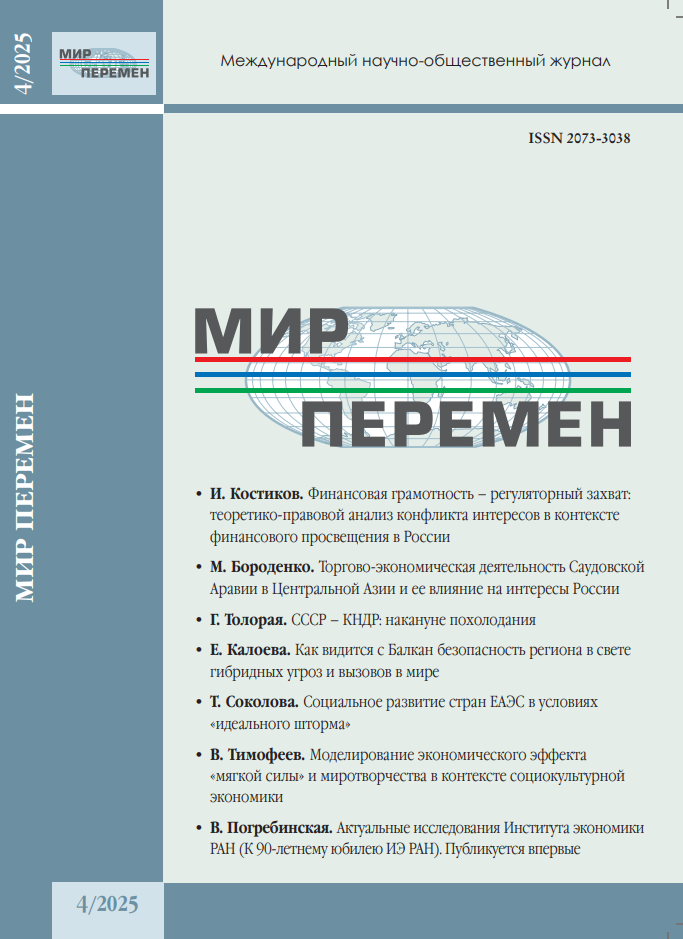
СОДЕРЖАНИЕ
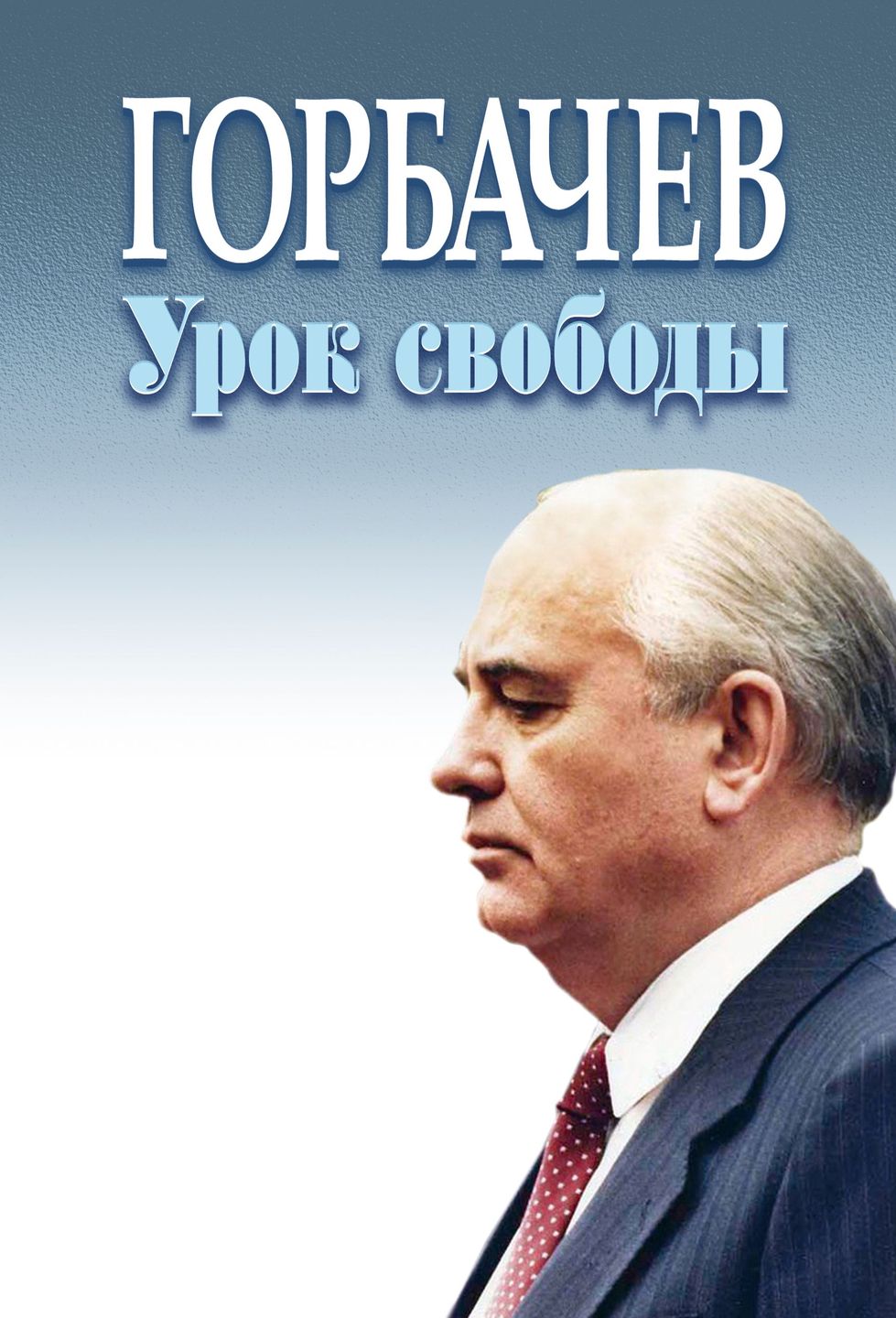
Непонятый пророк
М. Горбачев. Что побудило покончить с холодной войной (Выступление в Израильском технологическом институте «Технион», Хайфа, 15 июня 1992 г.)
М. Горбачев. Моя жизнь в политике (Выступление перед студентами Московского международного университета, 9 февраля 2012 г.)
Экономика
И. Костиков. Финансовая грамотность – регуляторный захват: теоретико-правовой анализ конфликта интересов в контексте финансового просвещения в России
М. Бороденко. Торгово-экономическая деятельность Саудовской Аравии в Центральной Азии и ее влияние на интересы России
Экономика. Незабытые имена
В. Погребинская. Актуальные исследования Института экономики РАН (к 90-летнему юбилею ИЭ РАН)
Т. Дробышевская. О Вере Александровне Погребинской
Политика
Г. Толорая. СССР – КНДР: накануне похолодания
Е. Калоева. Как видится с Балкан безопасность региона в свете гибридных угроз и вызовов в мире
В. Тимофеев. Моделирование экономического эффекта «мягкой силы» и миротворчества в контексте социокультурной экономики
А. Матлин, А. Сунгуров. Историография изучения петербургского парламентаризма 1990–1998 гг. (От Ленсовета XXI созыва к Заксобранию Санкт-Петербурга I созыва)
Социальная политика
Т. Соколова. Социальное развитие стран ЕАЭС в условиях «идеального шторма»
У книжной полки
А. Чепуренко. Сотрудничество российского бизнеса с бизнесом постсоветских стран. (Рецензия на монографию: Е. Я. Виттенберг, Е. И. Пивовар. Сотрудничество российского бизнеса с бизнесом постсоветских стран. М.: РГГУ. 2025 г.)
Публикации Института экономики РАН по международным проблемам в 2024–2025 г.
АННОТАЦИЯ
М. Горбачев. Что побудило покончить с холодной войной
Выступление в Израильском технологическом институте «Технион», Хайфа, 15 июня 1992 г.
Ключевые слова: холодная война, реформы, гонка вооружений, перестройка, новое мышление.
М. Горбачев. Моя жизнь в политике
Выступление перед студентами Московского международного университета, 9 февраля 2012 г.
Ключевые слова: семья, политика, встречи со студентами, образование, общественная работа, КПСС, Сталин, МГУ, Ставропольский край, застой, гласность, демократия, политический плюрализм, ГКЧП, распад СССР.
И. Костиков. Финансовая грамотность – регуляторный захват: теоретико-правовой анализ конфликта интересов в контексте финансового просвещения в России
УДК: 334.784
EDN: MONOVN
DOI: 10.51905/2073–3038_2025_4_21
Регуляторный захват в сфере развития финансовой грамотности возникает, когда контроль над финансовым просвещением концентрируется у акторов финансового сектора. В таком случае финансовый сектор формирует замкнутый контур влияния, в котором содержание финансового образования конструируется теми же субъектами, которые должны быть объектом независимой критической оценки. Последствиями такого взаимодействия являются высокий риск конфликта интересов ввиду недостаточной автономии регулятора и вытеснение независимых игроков. Явление устойчивого регуляторного захвата приводит к тому, что интересы одной отрасли ставятся выше общих интересов общества.
Ключевые слова: ассоциация развития финансовой грамотности, проблемы финансового образования, финансовый рынок России.
Игорь Владимирович Костиков – доктор экономических наук, профессор, Национальный институт финансовых рынков и управления (г. Москва).
М. Бороденко. Торгово-экономическая деятельность Саудовской Аравии в Центральной Азии и ее влияние на интересы России
УДК: 339.56
EDN: MOZZGJ
DOI: 10.51905/2073–3038_2025_4_40
В условиях текущей геополитической неопределенности последних лет страны Центральной Азии активно стараются диверсифицировать свои внешнеполитические и внешнеторговые связи. Помимо традиционных партнеров – России, Китая, Евросоюза, Индии, и др., – центральноазиатские республики стараются выстроить более тесные внешнеэкономические связи с монархиями Персидского залива, в частности с Саудовской Аравией, крупнейшей экономикой среди всех стран – членов Совета сотрудничества арабских государств Персидского залива (ССАГПЗ).
В представленной статье проанализировано, насколько активно КСА ведет торгово-экономическую деятельность в Центральной Азии, какие цели Эр-Рияд преследует в регионе и противоречат ли они интересам России.
Ключевые слова: Саудовская Аравия, Казахстан, Кыргызстан, Таджикистан, Туркменистан, Узбекистан, торговля, экспорт, импорт, инвестиции, кредиты.
Максим Максимович Бороденко – научный сотрудник Центра постсоветских исследований Института экономики РАН (г. Москва).
В. Погребинская. Актуальные исследования Института экономики РАН (к 90-летнему юбилею ИЭ РАН)
УДК: 330.8, 338
EDN: GNNPGO
DOI: 10.51905/2073-3038_2025_4_58
В год 95-летнего юбилея ИЭ РАН мы публикуем материал доктора экономических наук Веры Александровны Погребинской, который был создан к 90-летнему юбилею ИЭ РАН, но не был опубликован. Своей актуальности он не потерял. И мы с удовольствием знакомим с ним наших читателей. Цель настоящей статьи – вспомнить имена тех исследователей Института экономики РАН, чьи выводы актуальны для современности. Автор пишет о тех ученых, с которыми работал в отделе социалистического воспроизводства, ведущем в институте, что, безусловно, не исчерпывает всех ценных исследователей. Но этот избранный круг настолько значителен, что его выделение вполне оправданно.
Ключевые слова: российская экономическая мысль, экономическая теория, Институт экономики РАН, экономика СССР, экономический рост, стратегическое планирование.
Вера Александровна Погребинская – доктор экономических наук, профессор кафедры ИНХиЭУ экономического факультета МГУ имени М. В. Ломоносова (г. Москва).
Т. Дробышевская. О Вере Александровне Погребинской
EDN: GOPLEB
DOI: 10.51905/2073-3038_2025_4_67
Вера Александровна Погребинская родилась в Москве в 1944 г. В 1968 г. окончила исторический факультет МГУ. В 1975 г. защитила кандидатскую, в 2009 г. – докторскую диссертацию по специальности «экономическая теория (экон. науки)». С 1969 по 1998 г. работала в Институте экономики РАН в должности младшего, старшего и ведущего научного сотрудника. С 1995 по 1998 г. Вера Александровна совмещала работу в Институте экономики с преподаванием на экономическом факультете МГУ имени М. В. Ломоносова. Наконец, с 1998 г. основным местом работы Веры Александровны Погребинской становится кафедра истории народного хозяйства и экономических учений экономического факультета МГУ. Нужно быть очень смелым человеком, искренне уверенным в своем призвании, чтобы выбрать путь историка хозяйства, зная, что твои работы постоянно будут сравнивать с работами отца, признанного авторитета в области экономической истории, автора классической работы «Очерки истории финансов дореволюционной России (XIX-XX в.)», профессора Московского финансового института (сегодня – Финансовая академия при Правительстве РФ) Александра Петровича Погребинского.
Татьяна Александровна Дробышевская – кандидат экономических наук, доцент, заместитель заведующего кафедрой ИНХиЭУ по научной работе экономического факультета МГУ им М. В. Ломоносова (г. Москва).
Г. Толорая. СССР – КНДР: накануне похолодания
УДК: 327
EDN: IINKCR
DOI: 10.51905/2073–3038_2025_4_74
Статья посвящена анализу трансформации советско-северокорейских отношений в период перестройки (1985–1991). Политические и экономические реформы М. Горбачева, включая политику «нового мышления» и сближение с Южной Кореей, были восприняты руководством КНДР как прямая угроза стабильности режима Ким Ир Сена. На основе ранее не публиковавшихся архивных материалов МИД СССР, включая записи бесед с северокорейскими официальными лицами, реконструирован процесс стремительного ухудшения двусторонних отношений.
Особое внимание уделяется идеологическому противостоянию: если СССР видел в реформах путь к модернизации социализма, то Пхеньян рассматривал их как капитуляцию перед Западом. Ключевым моментом кризиса стало установление дипломатических отношений между СССР и Южной Кореей в 1990 г., что КНДР расценила как предательство союзнических обязательств. Автор показывает, как экономический разрыв (переход на расчеты в СКВ, прекращение советской помощи) усугубил политическую конфронтацию, а угрозы Пхеньяна создать ядерное оружие стали ответом на новую реальность.
В заключительной части статьи анализируется формирование российской политики в отношении КНДР после распада СССР, когда Москва была вынуждена балансировать между наследием союзного договора 1961 г. и желанием сотрудничества с Западом по ядерной проблеме. Исследование демонстрирует, что северокорейское руководство не только верно предсказало последствия советской политики, но и использовало этот опыт для укрепления своей изоляционистской модели развития.
Ключевые слова: советско-северокорейские отношения, крах социалистического блока, кризис союзного договора 1961 г., КНДР, СССР.
Георгий Давидович Толорая – доктор экономических наук, профессор, руководитель Центра стратегии России в Азии ИЭ РАН, главный научный сотрудник Центра мировой политики и стратегического анализа Института Китая и современной Азии РАН (г. Москва).
Е. Калоева. Как видится с Балкан безопасность региона в свете гибридных угроз и вызовов в мире
УДК: 327
EDN: ALAARE
DOI: 10.51905/2073–3038_2025_4_89
Гибридные угрозы и вызовы в современном мире – что они несут с собой и как с ними бороться? Не стал ли Балканский кризис 1990-х годов одним из первых полигонов для их испытания? Что делать, если в некоторых странах и регионах не может быть мира без войны? Как вести процесс примирения и возможен ли он без покаяния? На эти и другие актуальные для нашего времени вопросы дают ответы два балканских исследователя в книгах, вышедших в 2023 и 2024 г.
Ключевые слова: гибридные вызовы и угрозы, Балканы, балканский кризис, ЕС, российско-украинский конфликт.
Елена Борисовна Калоева – кандидат исторических наук, независимый исследователь (г. Москва).
В. Тимофеев. Моделирование экономического эффекта «мягкой силы» и миротворчества в контексте социокультурной экономики
УДК: 327.8; 316.334.2; 316.75
EDN: APMORB
DOI: 10.51905/2073-3038_2025_4_107
Недавние исследования автора показали, что миротворчество может обладать позитивным экономическим эффектом, который объясняется политической стабилизацией и обеспечением сильных институтов в странах, раздираемых конфликтами. Это означает, что внешнеполитические инструменты, используемые для достижения политических целей, могут позитивно влиять на экономику. При этом возникает вопрос: если миротворчество, рассматриваемое и как жесткая, и как «мягкая», и как «умная сила», воздействует на институты, то может ли «мягкая сила» иметь тот же экономический эффект?
Более того, следует также задаться вопросом, возможно ли рассматривать экономический эффект «мягкой силы» и миротворчества в более широком институциональном контексте, а именно – в рамках социокультурной экономики. Цель данного исследования заключается в том, чтобы определить, влияют ли такие инструменты внешней политики, как «мягкая сила» и миротворчество, на глобальный уровень благополучия с точки зрения социокультурной экономики.
Для достижения данной цели автор анализирует влияние таких факторов, как мировой доход индустрии звукозаписи, сборы самых кассовых фильмов «Марвел», общая численность негражданского персонала миротворческого контингента ООН, на мировой индекс человеческого развития (ИЧР) в рамках периода 2003–2021 гг. В рамках моделирования автором вводится допущение, согласно которому вестернизированная популярная культура – это «мягкая сила» как США, так и глобального капитализма.
Автор исходит из идей социокультурной экономики в рамках проведенного исследования. Методология заключается в применении регрессионного анализа для получения модели влияния факторов на результат. Была получена и интерпретирована аналитическая форма связи. Все факторы оказывают на результат положительное статистически значимое влияние. Автор делает вывод, что «мягкая сила» и миротворчество могут позитивно влиять на глобальный уровень благополучия, распространяя либеральные инклюзивные институты.
Ключевые слова: «мягкая сила», жесткая сила, «умная сила», социокультурная экономика, индекс человеческого развития, мировой доход индустрии звукозаписи, сборы самых кассовых фильмов «Марвел», общая численность негражданского персонала миротворческого контингента ООН, миротворчество, международный порядок.
Владимир Владимирович Тимофеев – кандидат политических наук, старший преподаватель кафедры общественных наук Санкт-Петербургского государственного университета промышленных технологий и дизайна (г. Санкт-Петербург).
А. Матлин, А. Сунгуров. Историография изучения петербургского парламентаризма 1990–1998 гг. (От Ленсовета XXI созыва к Заксобранию Санкт-Петербурга I созыва)
УДК 930
EDN: BVHYBI
DOI: 10.51905/2073–3038_2025_4_127
Цель исследования – представить обзор современного состояния историографии становления петербургского парламентаризма в переходный период 1990-х годов.
Научная новизна заключается в систематизации и каталогизации основных направлений историографии изучаемого вопроса: исследования участников событий, фундаментальные издания, мемуарная литература, диссертационные работы, публикации по избирательным процессам и законотворческой деятельности. Особое внимание уделено анализу источниковой базы и методологических подходов существующих исследований.
Исследование охватывает два последовательных этапа развития региональной представительной власти: деятельность Ленинградского городского совета XXI созыва (1990–1993) и формирование Законодательного собрания Санкт-Петербурга первого созыва (1994–1998). В результате авторы выявляют существенную диспропорцию в степени научного освоения указанных периодов. Если Ленсовет XXI созыва получил достаточно широкое освещение в научной литературе благодаря участию в его работе представителей академической среды и драматическим политическим событиям эпохи, то деятельность первого созыва Законодательного собрания изучена менее подробно.
В заключение авторы определяют перспективные направления дальнейших исследований. Статья адресована специалистам в области политической истории России, регионоведения и парламентаризма, а также всем исследователям, изучающим процессы демократизации в постсоветской России.
Ключевые слова: историография, петербургский парламентаризм, Ленсовет XXI созыва, Законодательное собрание Санкт-Петербурга, региональная власть.
Александр Дмитриевич Матлин – преподаватель кафедры истории и философии гуманитарного факультета, Санкт-Петербургский государственный университет аэрокосмического приборостроения; аспирант кафедры русской истории XIX–XXI в. РГПУ им. А. И. Герцена (г. Санкт-Петербург).
Александр Юрьевич Сунгуров – доктор политических наук, научный руководитель Народного университета современного конституционализма имени Г. Э. Бурбулиса (г. Санкт-Петербург).
Т. Соколова. Социальное развитие стран ЕАЭС в условиях «идеального шторма»
УДК: 339.923; 339.924
EDN: BWBEDA
DOI: 10.51905/2073-3038_2025_4_146
В статье проанализирована динамика социального развития стран ЕАЭС в 2015–2025 гг., выявлены внутренние и внешние причины социальных проблем. В контексте меняющегося миропорядка и нарастания геополитической и геоэкономической напряженности проанализированы евразийские интеграционные процессы и дана оценка их влияния на социальную сферу.
Ключевые слова: ЕАЭС, меняющийся миропорядок, евразийская интеграция, социальное развитие, уровень жизни, неравенство, бедность, миграции.
Татьяна Владимировна Соколова – кандидат экономических наук, старший научный сотрудник Центра постсоветских исследований ИЭ РАН (г. Москва).
А. Чепуренко. Сотрудничество российского бизнеса с бизнесом постсоветских стран. (Рецензия на монографию: Е. Я. Виттенберг, Е. И. Пивовар. Сотрудничество российского бизнеса с бизнесом постсоветских стран. М.: РГГУ. 2025 г.)
УДК: 339.5; 339.9
EDN: CXNWXH
DOI: 10.51905/2073–3038_2025_4_163
После распада СССР на его бывшем пространстве происходят многочисленные разнонаправленные экономические процессы. Они уже становились предметом ряда публикаций в отечественных академических изданиях. Но исследований, посвященных той роли, которую играют в этих процессах такие новые для постсоветских стран агенты, как частные предприниматели, практически нет. С этой точки зрения рецензируемая монография представляет несомненный интерес как первый ретроспективный взгляд на кооперационные процессы, которые в новых условиях ведут к иной структуре экономических связей между Россией и некоторыми ее соседями. Новые геополитические реальности, процессы деглобализации объективно требуют пристального внимания к тем возможностям использования международного разделения труда, которые сохраняются и которые у России объективно сегодня связаны именно с остающимися на периферии научных исследований бывшими советскими республиками.
Ключевые слова: частное предпринимательство; ЕВРАЗЭС; СНГ; кооперация; торговля.
Александр Юльевич Чепуренко – доктор экономических наук, профессор, Национальный исследовательский университет Высшая школа экономики (г. Москва).
Contents
The Misunderstood Prophet
M. Gorbachev. What Prompted the End of the Cold War (Speech at the Technion Israel Institute of Technology, Haifa, June 15, 1992)
M. Gorbachev. My Life in Politics (Speech to Students of Moscow International University, February 9, 2012)
Economy
I. Kostikov. Financial Literacy – Regulatory Capture: Theoretical and Legal Analysis of Conflicts of Interest in the Context of Financial Education in Russia
M. Borodenko. Saudi Arabia’s Trade and Economic Activities in Central Asia and Their Impact on Russia’s Interests
Economy. Unforgettable Names
V. Pogrebinskaya. Current Research of Institute of Economics of the Russian Academiy of Sciences (Dedicated to the 90th anniversary of IE RAS)
T. Drobyshevskaya. About Vera Alexandrovna Pogrebinskaya
Politics
G. Toloraya. USSR-DPRK: on the Eve of a Freeze
E. Kaloeva. How the Security of the Region is Seen from the Balkans in Light of the Hybrid Threats and Conflicts that Exist in the World
V. Timofeev. Modelling the Economic Effects of «Soft Power» and Peacekeeping in the Context of Sociocultural Economics
A. Matlin, A. Sungurov. Historiography of the Study of St. Petersburg Parlamentarism 1990-1998 (From the Lensovet of the XXI convocation to the Legislative Assembly of St. Petersburg of the First convocation)
Social policy
T. Sokolova. Social Development of the EAEU Cuntries in the Context of the «Perfect Storm»
At the Bookshelf
A. Chepurenko. Cooperation between Russian Business and Business in Post-Soviet Countries (Review of the monograph: E. J. Wittenberg, E. I. Pivovar. Cooperation of Russian business and business in post-Soviet countries. Moscow, RGGU Publishing House. 2025)
Publications of the Institute of Economics of the Russian Academy of Sciences on International Issues in 2024–2025
Summary
M. Gorbachev. What Prompted the End of the Cold War
Speech at the Technion Israel Institute of Technology, Haifa, June 15, 1992
Annotation. I am often asked: what were the motivations behind my determination to end the Cold war when I found myself at the head of a powerful state? First of all, I call the moral motive. The pursuit of victory in an ideological battle, which was a source of confrontation, not only caused great damage to the moral values of life. It threatened a catastrophe for life itself, the elimination of the very object of morality.
Keywords: cold war, reforms, arms race, perestroika, new thinking.
Mikhail S. Gorbachev – General Secretary of the Central Committee of the CPSU, the First and Last President of the USSR (Moscow).
M. Gorbachev. My Life in Politics
Speech to Students of Moscow International University, February 9, 2012
Annotation: Thank you, friends, for the invitation!
I haven’t been performing that much lately (age, health condition). In general, I am currently in the process of adapting to a new stage of life. If you live to be eighty–one, I think you’ll understand. But, nevertheless, as you can see, I am in the ranks. Last year, I met with students from four faculties of Moscow University. He gave a lecture and answered 108 questions. At the end of last year, I gave lectures in Belgium, Canada, Mexico and the United States of America. And this time, speaking to students took a big place for me.
It takes me the most time to work on myself, and my responsibilities in managing the Gorbachev Foundation, the International Green Cross, the New Politics Forum, and the Forum of Nobel Peace Prize Laureates. There are other, less demanding tasks.
Keywords: family, politics, meetings with students, education, public work, CPSU, Stalin, Moscow State University, Stavropol Territory, stagnation, glasnost, democracy, political pluralism, Emergency Committee, collapse of the USSR.
Mikhail S. Gorbachev – General Secretary of the Central Committee of the CPSU, the First and Last President of the USSR (Moscow).
I. Kostikov. Financial Literacy – Regulatory Capture: Theoretical and Legal Analysis of Conflicts of Interest in the Context of Financial Education in Russia
Annotation: Regulatory capture in the field of financial literacy development arises when control over financial education is concentrated in the hands of actors from the financial sector. In such cases, the financial sector creates a closed loop of influence in which the content of financial education is shaped by the very entities that ought to be the object of independent critical assessment. The consequences of this arrangement include a high risk of conflicts of interest due t o the regulator’s insufficient autonomy and the displacement of independent players. Persistent regulatory capture results in the interests of a single industry being placed above the broader public interest.
Keywords: Association for the Development of Financial Literacy (ARFG), challenges in financial education, the Russian financial market.
Igor V. Kostikov – Doctor of Economics, Professor, National Institute of Financial Markets and Management (Moscow).
M. Borodenko. Saudi Arabia’s Trade and Economic Activities in Central Asia and Their Impact on Russia’s Interests
Annotation. In the current geopolitical uncertainty, the Central Asian countries have been actively diversifying their foreign policy and trade relations in recent years. In addition to their traditional partners, such as Russia, China, the European Union, India, and others, the Central
Asian republics are seeking to establish closer economic ties with the Gulf monarchies, particularly Saudi Arabia, which is the largest economy among the Cooperation Council for the Arab States of the Gulf member states. In this article, we will analyze how actively the KSA engages in trade and economic activities in Central Asia, what goals Riyadh pursues in the region, and whether they contradict Russia’s interests.
Keywords: Saudi Arabia, Kazakhstan, Kyrgyzstan, Tajikistan, Turkmenistan, Uzbekistan, trade, exports, imports, investments, loans.
Maxim M. Borodenko – Research associate at the Institute of Economics of the Russian Academy of Sciences (Moscow).
V. Pogrebinskaya. Current Research of Institute of Economics of the Russian Academiy of Sciences (Dedicated to the 90th anniversary of IE RAS)
Annotation. In the year of the 95th anniversary of the Institute of Economics of the Russian Academy of Sciences, we publish the material of Vera Alexandrovna Pogrebinskaya, Doctor of Economics, which was created for the 90th anniversary of the Institute of Economics of the Russian Academy of Sciences, but was not published. It has not lost its relevance. And we are pleased to introduce it to our readers.
* * *
The change in the social system in Russia at the end of the last century led to a sharp denial of the achievements of the Russian economic science of the twentieth century. Such denial is harmful to modern development, which cannot be mechanically divorced from the past, which is largely reflected in the theoretical research of the twentieth century. In any case, this applies to those studies that proceeded from institutions common to the developed economy, regardless of the definitions of the socioeconomic system.
The Russian reality of the twentieth century did not correspond to the educational definitions of socialism, just as the modern one did not correspond to capitalism. Public property was replaced by highly monopolized state property, and the absence of private property was replaced by its shadowy forms. Significant accumulations in the shadow sector and the need to legalize them became one of the main reasons for the revolution of the 1990s in Russia. The events of this period objectively matured throughout the second half of the twentieth century and genuine academic economists who are not associated with political dogmas saw them in the declining efficiency of domestic production, in comparison with developed countries, suggesting possible ways to stabilize and increase it.
The purpose of this article is to recall the names of those researchers at the Institute of Economics of the Russian Academy of Sciences, whose conclusions are relevant to our time. The author writes about those scientists with whom he worked in the Department of Socialist Reproduction at the Institute, which certainly does not exhaust all valuable researchers. But this select group is so significant that its allocation is fully justified.
Keywords: Russian economic thought, economic theory, Institute of Economics of the Russian Academy of Sciences, economy of the USSR, economic growth, strategic planning.
Vera A. Pogrebinskaya – a Doctor of Economics, Professor at the Department of Economic Management at the Faculty of Economics of Lomonosov Moscow State University (Moscow).
T. Drobyshevskaya. About Vera Alexandrovna Pogrebinskaya
Annotation. Vera Alexandrovna Pogrebinskaya was born in Moscow in 1944. In 1968 she graduated from the Faculty of History of Moscow State University. In 1975, she defended her PhD, and in 2009, her doctoral dissertation, specializing in Economic Theory (Economics). From 1969 to 1998, she worked at the Institute of Economics of the
Russian Academy of Sciences as a junior, senior and leading researcher. From 1995 to 1998, Vera Alexandrovna combined her work at the Institute of Economics with teaching at the Faculty of Economics of Lomonosov Moscow State University. Finally, since 1998. Vera Alexandrovna Pogrebinskaya’s main place of work is becoming the Department of the History of National Economy and Economic Studies at the Faculty of Economics of Moscow State University.
You need to be a very brave person, sincerely confident in your vocation, to choose the path of an economic historian, knowing that your work will constantly be compared with the work of your father, a recognized authority in the field of economic history, author of the classic work “Essays on the History of Finance in pre-revolutionary Russia (XIX-XX centuries)” professor at the Moscow Financial Institute (today it is Financial Academy under the Government of the Russian Federation) by Alexander Petrovich Pogrebinsky
Keywords: Russian economic thought, economic theory, Institute of Economics of the Russian Academy of Sciences, economy of the USSR, economic growth, strategic planning
Tatiana A. Drobyshevskaya – a Candidate of Economics, Associate Professor, Deputy Head of the Department of the Institute of Economics for Scientific Research at the Faculty of Economics of the Lomonosov Moscow State University (Moscow).
G. Toloraya. USSR-DPRK: on the Eve of a Freeze
ORCID: 0000–0002–3685–2120
Abstract. G. D. Toloraya’s article ‘USSR – DPRK: on the Eve of Collapse’ is an in-depth analysis of the transformation of Soviet-North Korean relations during the perestroika period (1985–1991). The author explores how Gorbachev’s political and economic reforms, including the policy of ‘new thinking’ and rapprochement with South Korea, were perceived by the DPRK leadership as a direct threat to the stability of Kim Il-sung’s regime. Based on previously unpublished archival materials of the USSR Foreign Ministry, including recordings of conversations with North Korean officials, Toloraya reconstructs in detail the process of rapid deterioration of bilateral relations. Particular attention is paid to the ideological confrontation: while the USSR saw reforms as a way to modernise socialism, Pyongyang saw them as a capitulation to the West. The key moment of the crisis was the establishment of diplomatic relations between the USSR and South Korea in 1990, which the DPRK regarded as a betrayal of its allied obligations. The author shows how the economic rupture (the transition to settlement in hard currencies and the cessation of Soviet aid) aggravated the political confrontation, and Pyongyang’s threats to develop nuclear weapons were a response to the new reality. The final part of the article analyses the formation of Russian policy towards the DPRK after the collapse of the USSR, when Moscow was forced to balance the legacy of the 1961 Union Treaty with the desure to cooperate with the West on the nuclear issue. The study demonstrates that the North Korean leadership not only correctly predicted the consequences of perestroika for the USSR, but also used this experience to strengthen its isolationist model of development.
Keywords: Soviet-North Korean relations, collapse of the socialistbloc, crisis of the 1961 Treaty, DPRK, USSR
Georgy D. Toloraya – Doctor of Economics, Professor, Head of the Centre for Russian Strategy in Asia, Institute of Economics, Russian Academy of Sciences; Chief Researcher of the Centre for World Policy and Strategic Analysis, Institute of China and Contemporary Asia, Russian Academy of Sciences (Moscow).
E. Kaloeva. How the Security of the Region is Seen from the Balkans in Light of the Hybrid Threats and Conflicts that Exist in the World
Abstract. How the Security of the Region is Seen from the Balkans in Light of the Hybrid Threats and Conflicts that Exist in the World Annotation. Hybrid threats and challenges in the modern world – what do they bring with them and how can they be dealt with? Wasn’t the Balkan crisis of the 1990s one of the first testing grounds for them? What should be done if there can be no peace without war in some countries and regions? How to conduct the process of reconciliation and is it possible without repentance?
These and many other questions relevant to our time are answered by two Balkan researchers in their books published in 2023 and 2024.
Keywords: hybrid challenges and threats, Balkans, Balkan crisis, EU, Russian-Ukrainian conflict.
Elena B. Kaloeva – Candidate of Sciences, Ph.D, in history, freelance researcher (Moscow).
V. Timofeev. Modelling the Economic Effects of «Soft Power» and Peacekeeping in the Context of Sociocultural Economics
Annotation. The author’s recent research works have shown that peacekeeping can have positive economic effects that stem from achieving the political stability and strengthening the institutions in war-torn countries. This means that foreign policy tools which are used for the pursuit of political objectives can have a positive impact on the economy.
This raises the question: «If peacekeeping, seen as hard, soft and smart power, affects institutions, can traditional soft power instruments have the same economic effects?» Moreover, it should also be questioned whether it is possible to consider the economic effects of soft power and peacekeeping in the wider institutional context, namely within the framework of Sociocultural Economics. The goal of this research is to define whether such foreign policy tools as soft power and peacekeeping influence the global level of well-being in terms of Sociocultural Economics. To achieve this goal the author analyzes how such factors as global recorded music revenue, global box office revenue of the highest-grossing Marvel Comics movies, total number of non-civilian personnel of the UN peacekeeping contingent influence the World Human
Development Index (World HDI) between 2003 and 2021. The author suggests that the Westernized mass culture is the soft power of both the United States and global capitalism. The author proceeds from the ideas of Sociocultural Economics in this research. The methodology includes regression analysis, which is used to obtain a model describing the influence of factors on the outcome. The analytical form of dependence was found and interpreted. All factors have a positive statistically significant effect on the result. The author concludes that soft power and peacekeeping can have a positive impact on global well-being by spreading liberal and inclusive institutions.
Keywords: soft power, hard power, smart power, Sociocultural Economics, Human Development Index, global recorded music revenue, global box office revenue of the highest-grossing Marvel Comics movies, total number of non-civilian personnel of the UN peacekeeping contingent, peacekeeping, international order.
Vladimir V. Timofeev – PhD in Political Science, Senior Lecturer, Department of Social Sciences, Saint Petersburg State University of Industrial Technologies and Design (Saint Petersburg).
A. Matlin, A. Sungurov. Historiography of the Study of St. Petersburg Parlamentarism 1990-1998 (From the Lensovet of the XXI convocation to the Legislative Assembly of St. Petersburg of the First convocation)
Annotation. The purpose of the research: to provide an overview of the current state of historiography of the formation of St. Petersburg parliamentarism in the transitional period of the 1990s. The scientific novelty lies in the systematization and cataloging of the main areas of historiography of the issue under study: studies of participants in events, fundamental publications, memoir literature, dissertations, publications on electoral processes and legislative activity. Special attention is paid to the analysis of the source base and methodological approaches of existing research.
The study covers two successive stages in the development of regional representative government: the activities of the Leningrad City Council of the XXI convocation (1990–1993) and the formation of the Legislative Assembly of St. Petersburg of the first convocation (1994–1998). As a result, the authors identify a significant disparity in the degree of scientific development of these periods. If the Lensovet of the XXI convocation received a fairly wide coverage in the scientific literature dueto the participation of representatives of the academic community and the dramatic political events of the era in its work, then the activities of the first convocation of the Legislative Assembly have been studied in much less detail.
In conclusion, the authors identify promising areas for further research. The article is addressed to experts in the field of Russian political history, regional studies and parliamentarism, as well as to all researchers studying the processes of democratization in post-Soviet Russia.
Keywords: historiography, St. Petersburg parliamentarism, Lensovet of the XXI convocation, Legislative Assembly of St. Petersburg, regional government.
Alexander D. Matlin – Lecturer in the Department of History and Philosophy (Department 61) of the Faculty of Humanities, Saint Petersburg State University of Aerospace Instrumentation; postgraduate student in the Department of 19th-21st Century History, Herzen State Pedagogical Univ. (Saint Petersburg).
AuthorID: 995192
SPIN-код: 2948–9075
ORCID: https://orcid.org/0009–0002–1502–1931
Alexander Y. Sungurov – Doctor of Political Science, Academic Director of the National University Of Modern Constitutionalism Named After G. E. Burbulis (Saint Petersburg).
AuthorID: 615464
SPIN-код: 4555–4180
ORCID: https://orcid.org/0000–0003–4834–063X
T. Sokolova. Social Development of the EAEU Cuntries in the Context of the «Perfect Storm»
Annotation. The article analyzes the dynamics of the social development of the EAEU countries in 2015–2025, identifies internal and external causes of social problems. In the context of the changing world order and the growing geopolitical and geo-economic tensions, the Eurasian integration processes are analyzed and their impact on the social sphere is assessed.
Keywords: EAEU, the changing world order, Eurasian integration, social development, standard of living, inequality, poverty, migration.
Tatyana V. Sokolova – Cand. Sci. (Econ.), Senior Researcher, Institute of Economics, Russian Academy of Sciences (Moscow).
A. Chepurenko. Cooperation between Russian Business and Business in Post-Soviet Countries (Review of the monograph: E. J. Wittenberg, E. I. Pivovar. Cooperation of Russian business and business in post-Soviet countries. Moscow, RGGU Publishing House. 2025)
Abstract. After the collapse of the USSR, numerous multidirectional economic processes took place in its former territory. They have already been the subject of a number of publications in Russian academic journals. However, there are practically no studies devoted to the role that agents new to post-Soviet countries, such as private entrepreneurs, play in these processes. From this point of view, the reviewed monograph is of undoubted interest as the first retrospective look at the cooperative processes that in the new conditions lead to a different structure of economic relations between Russia and some of its neighbors. The new geopolitical realities, the processes of deglobalization, objectively require close attention to the possibilities of using the international division of labor that persist and which Russia objectively has today precisely with the former Soviet republics remaining on the periphery of scientific research.
Keywords: private enterprise; EurAsEC; CIS; cooperation; trade
Alexander Y. Chepurenko – Dr of Economics, Professor, HSE University (Moscow).